Showing posts with label chemise gown. Show all posts

Sunday, September 6, 2015

A Summer Chemise


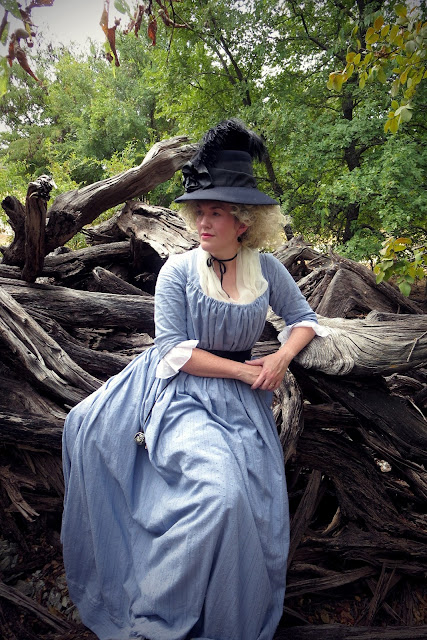
A friend of mine was hosting an 18th c. themed birthday party this weekend, and I decided at the last minute that I wanted a new dress that lightweight enough to be comfortable in our lingering summer heat. It's still in the high 90's here in Texas, so I thought a new chemise gown would be well worth a little detour from my other sewing and blogging plans. I also couldn't resist joining my friends, who were also wearing chemises to the party. I'm such a sucker for a theme!
 
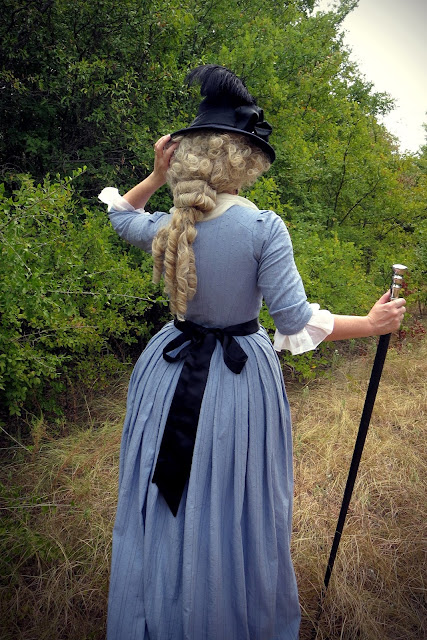
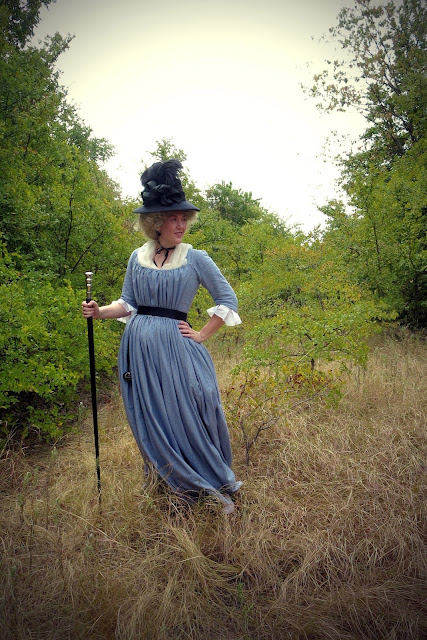
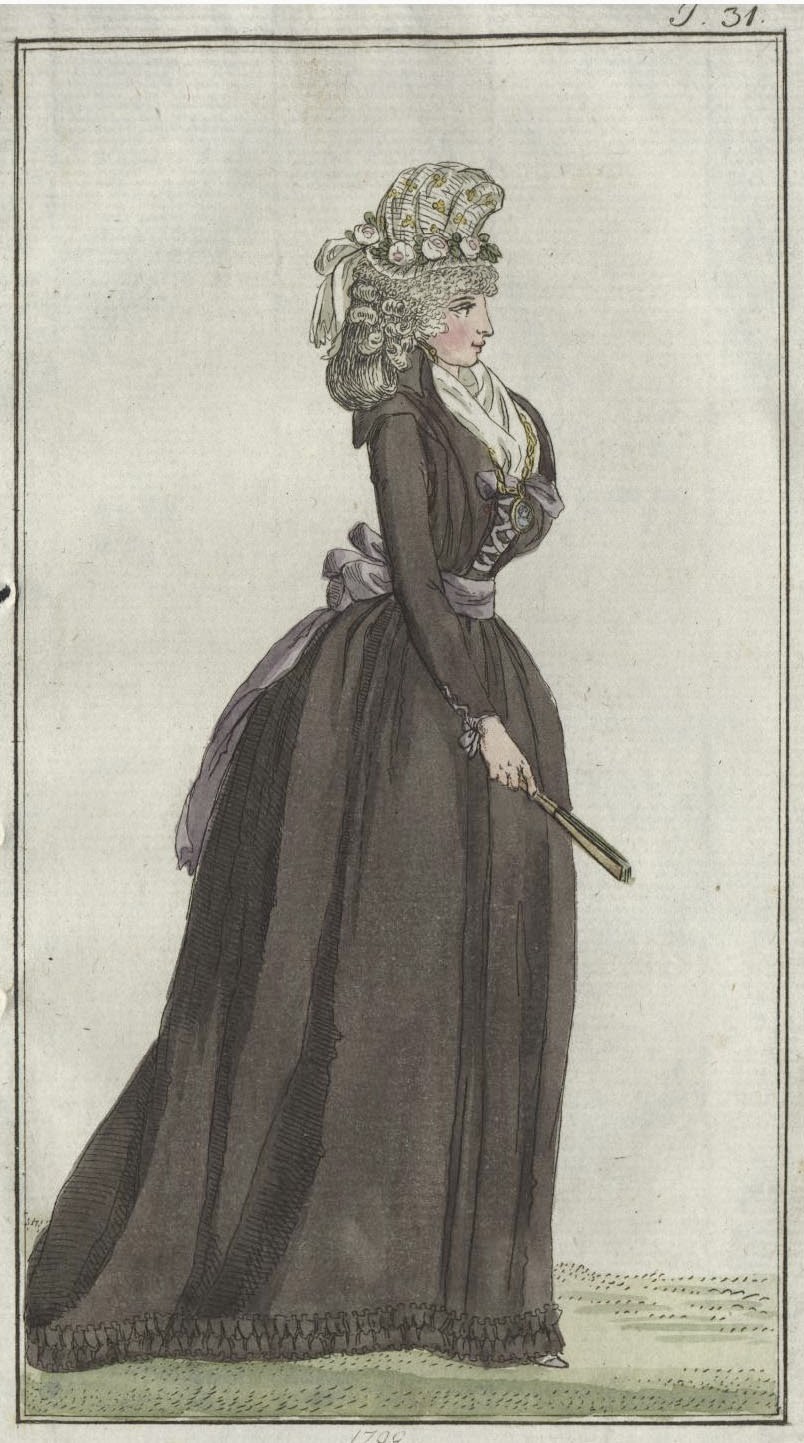
The fabric is a figured cotton with woven stripes and dots, and it was originally brown.  I bleached it and then re-dyed it to be a periwinkle blue-grey color.  I thought the color that I ended up with was a nice match to the hue in this lovely fashion plate from Cabinet des Modes.  I originally wanted to make a ruffled neckline and hem to make my dress match this fashion plate even closer, but I only had around 4 yards of fabric to work with, so I didn't have enough left over for ruffles.  

Although colored chemise gowns during this time period are plentiful, it's hard to find much evidence for cotton chemise gowns in colors other than white.   Most of the surviving examples and period references show that colored chemises were typically made of silk.  But there is one fashion plate that shows a chemise of pink English muslin, and as far as I know, 18th c. muslin was always made of cotton instead of silk, so I'm hoping that little tidbit of evidence is good enough to let me get away with this somewhat unusual material.
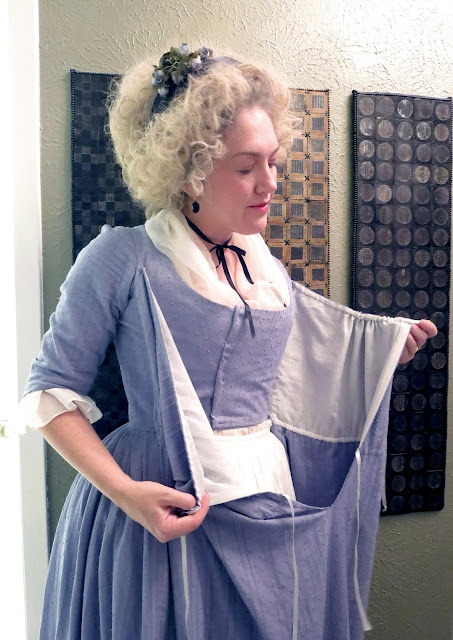

I used the same basic pattern that I created for my black chemise a few years ago, but this time I made elbow length sleeves and only had 2 drawstrings on the bodice instead of 3.  Chemise gowns with fitted backs are very easy to construct, and I think they are a lot less fiddly than the kind that are gathered all the way around.  I took a picture while I was getting dressed to give you a peek at the construction.  It's really just a basic round gown with a gathered section attached over the front of the bodice, and this panel is stitched down on to the bodice at the sides and tied in the center with ribbons.

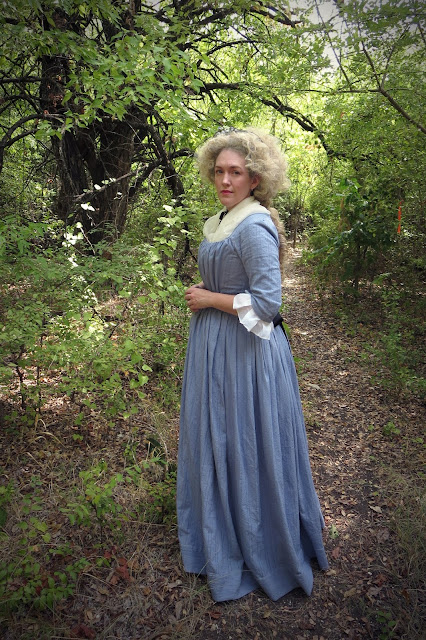
For the party last night, I just wore a simple ribbon and some flowers in my hair since this seems to be a very common look for ladies in portraits from the late 1780's and early 1790's.  But I also loved the way the dress looked with my black tall hat, so I took some photos of both styles while tromping though the woods at my local park today.  Here are a few of my favorite shots, and there are a few more pictures on flickr.


Thursday, April 3, 2014

Chemise gown research LUV!

Back in the Dark Ages of the internet, one of the costumers who inspired me and taught me more than any other was Sarah Lorraine of the Mode Historique website, and once again she is knocking my socks off with her newest research.  She is an AMAZING costumer and historian, and she has been specifically studying the Chemise à la Reine for the past few years for her graduate thesis in art history.  Sarah has generously decided to share some of her breakthrough findings with us by creating a Chemise à la Reine month, with 30 days of fabulous posts about this revolutionary article of clothing!  

And to conclude her research, Sarah is hoping to return to England to study the only extant 1780-1785 chemise gown, off the mannequin and outside of the display case, but she needs our help to get there.   She has created an Indegogo campaign to help pay for her travel expenses, and if you have a little that you could pitch in, it would be a wonderful way to thank Sarah for sharing her discoveries with us all.  I can't wait to read and learn more about this fascinating type of dress throughout April, and I'm even more excited to see what additional knowledge Sarah can discover if she is able to fully study a surviving chemise gown in person.  I think this is such an exciting project, and I hope you all will consider helping her out on this journey!


Monday, August 6, 2012

A proper mourning

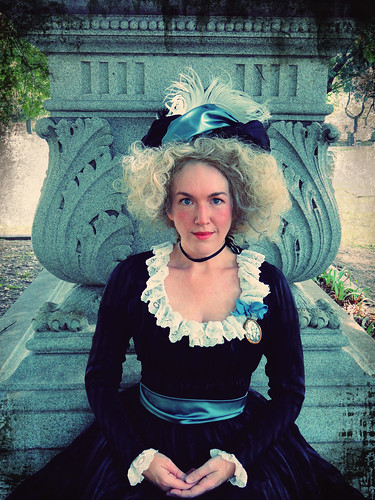
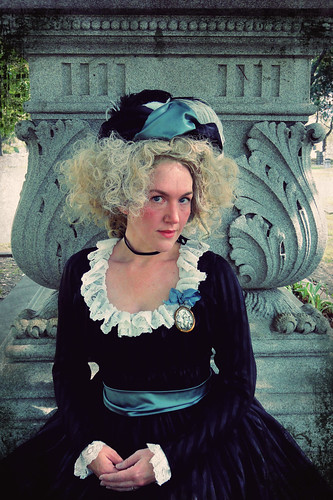
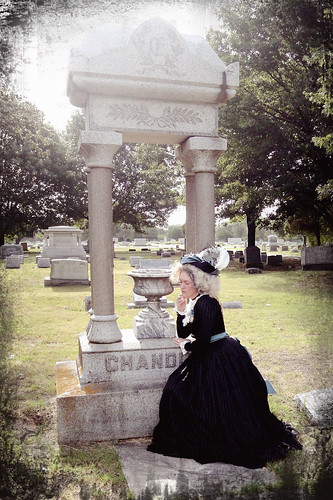
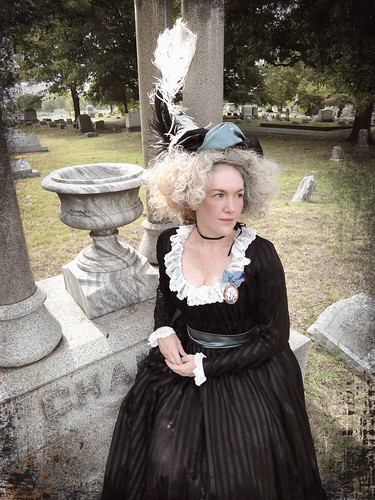
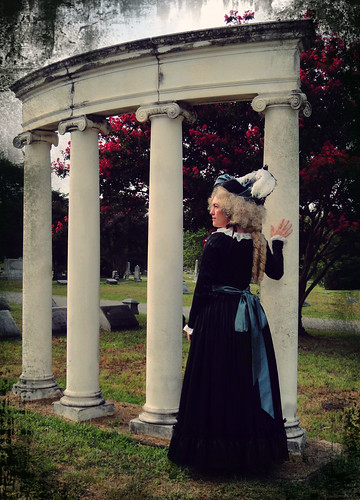
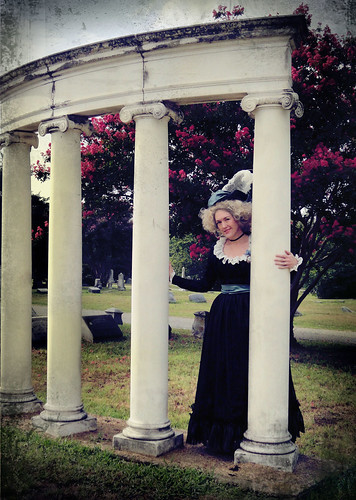
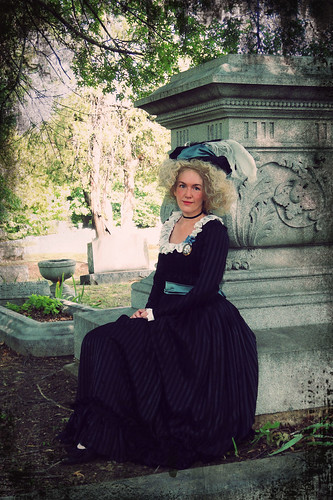
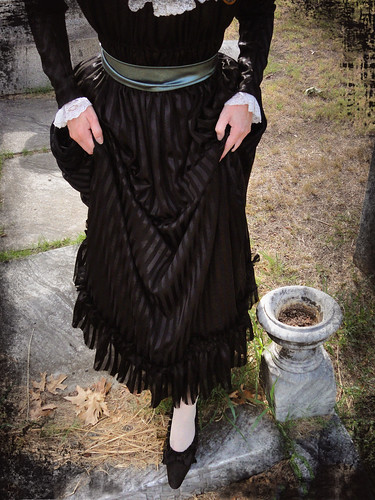
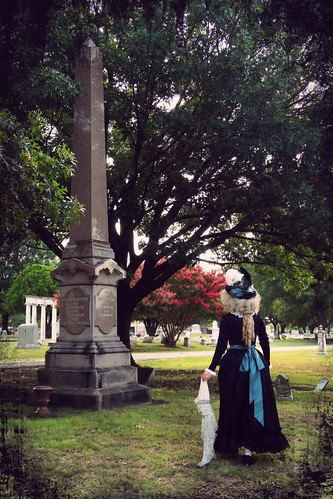
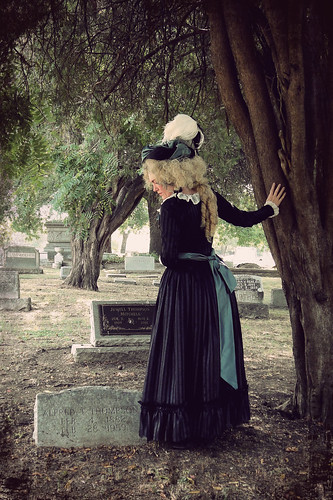
Because I am the world's biggest dork, I decided that my new black robe en chemise needed its own photo shoot. So I hauled my trusty tripod up to a beautiful historic cemetery in McKinney and pranced around the graves taking gothy pictures of myself... much to the amusement of the hard working grave diggers and city street workers.

But I think it was worth the effort because I got some shots that I really like - and truly, costuming is all about the pretty pictures, right? Now after wearing this dress a few times, I think it might be my new favorite outfit ever. I had no idea such a simple dress would be so much fun to wear!

DSC00231

DSC00245
Am I allowed to be saucy in a cemetery?
DSC00198

DSC00194

DSC00208
It was a bit windy that day - I think my feather was trying to take flight!

DSC00168

DSC00166

DSC00219

DSC00206

DSC00262

DSC00170

DSC00180

DSC00257
This was a tombstone for another Thompson, so of course I had to take a picture with it.  
Who knows - maybe we're related.

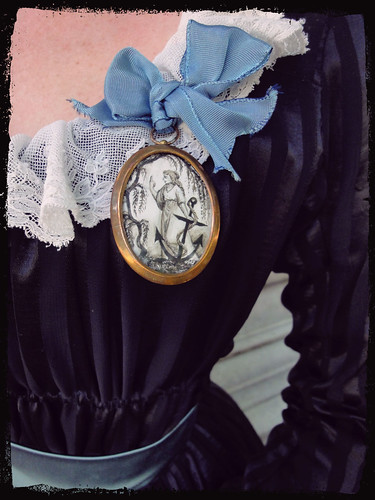
The one last thing that I wanted to mention about this outfit is my mourning miniature. Mourning jewelry was hugely popular in the Georgian period, so I decided try my hand at painting something for my own outfit. I based my design on this mourning brooch from 1788.  Anchors were very popular in mourning jewelry, and they symbolized hope.  My version is painted with guache on yupo paper, which is the closest substitute that I've found so far to ivory.  This version is quite ham-fisted compared to the delicately painted original, but I still like it.  It was a lot of fun to make.

DSC00252


Monday, July 23, 2012

black chemise - sneak peek


DSC00123
DSC00143

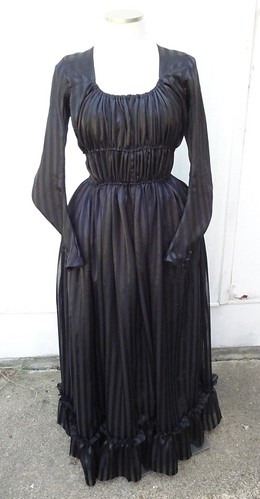
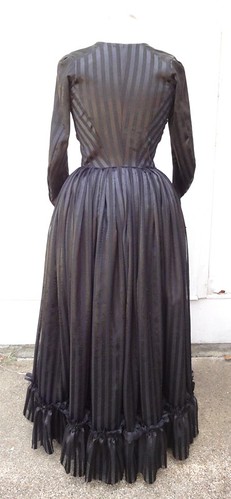
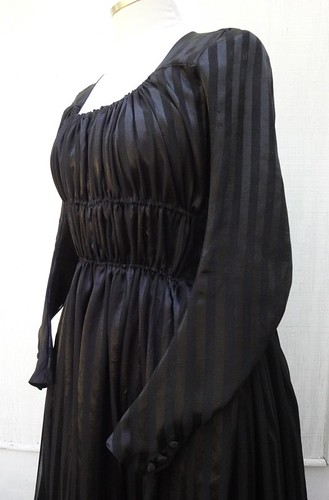
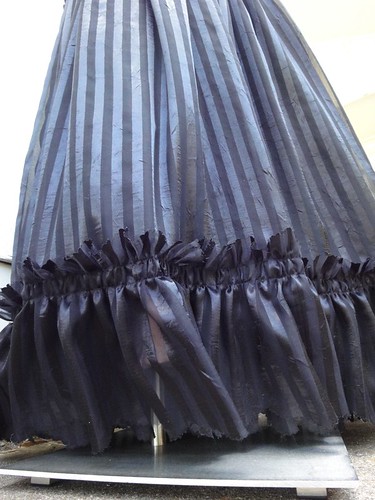
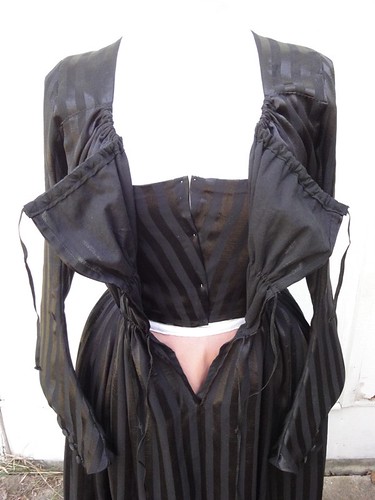
I finished my black chemise gown yesterday, so I decided to put it on a manikin and share a few pics showing the construction.   It is so hard to see details on an all black dress in most photos, so I have adjusted the exposure so you can see everything more clearly.

The gown is made of synthetic striped chiffon, and it is lined with black cotton voile.  The fabric was originally crinkle chiffon, and I have spent countless hours trying to iron it flat.  It got pretty close, but you can see that some of the crinkles still remain.  But I had my heart set on having a striped chemise dress like the one seen in this portrait, and this fabric was the only sheer black striped fabric that I could find.

I based much of the construction for my dress on this green silk chemise gown from the 1790's.  I was SO thrilled to finally see a back view of a fitted-back chemise gown, so I tried to make my own gown have a similar back. My pattern mimics the bodice seamlines, waist shape, and skirt pleating, although some changes still had to be made due to my tighter sleeves and the high back of my corset.


Many other elements of my dress were inspired by this chemise gown from the late 1780's, posted by Heileen of the Costume Hysteric blog. Like this example, my dress has tight sleeves with buttons at the cuff, a triple row of drawstrings across the torso, and a ruffle at the hem.

To dress up the ruffle a little, I pinked the edges with some scalloped pinking sheers, and I really like the effect, but I'm not sure how well it would hold up if this dress was going to get a lot of wear and tear.  My chiffon likes to ravel.


I have seen several theories about how these fitted chemise gowns were closed (I wish the museums included this information!), but my personal theory is that most of them have a front slit that is concealed by the gathers in the fabric.  There is a gathered-front jacket on the Abiti Antichi website that shows this type of construction especially well since one side of the gathered front is missing.  My bodice has a fitted under-layer that is pinned closed at the center front, and then the gathered outer layer has a opening that extends a little past the waist.  The drawstrings tie in the center and just get tucked under the gathered outer layer.  There is so much fabric there that you really can't see the opening once it is tied.
DSC00148

I recently had a very interesting discussion with some friends about the difference between dresses made for historical reenactment purposes and "pretty-pretty-princess" dresses.  Although I have tried to base my design on good historical research, the materials and construction of this outfit are 100% precent pretty-pretty-princess... and I'm totally okay with that!  It was a welcome change of pace to make something where I didn't obsess over natural fibers or period construction techniques or try to do tons of hand-sewing.   I think it will be a lot of fun to wear, and sometimes that's all that really matters.

Thursday, July 12, 2012

black chemise gowns


At the DWCG's first overnight event - Costumers' Lost Weekend - we decided to mix things up a bit.   Instead of having a big fancy gala, we're going to have a Mourning Party.  The idea for our mini-con actually grew from a few of us talking about having a "pity party" for the folks who can't make it out to Costume College this year, so we thought it would be cheeky and fun to have a party to mourn the fact that we are stuck here in Texas instead of living it up in LA.

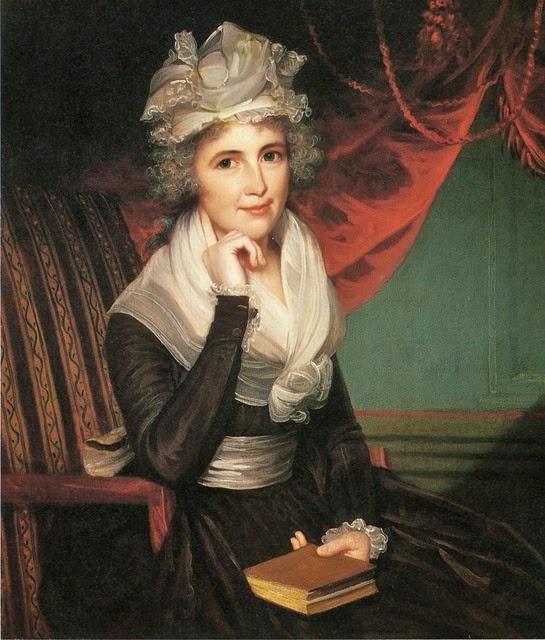
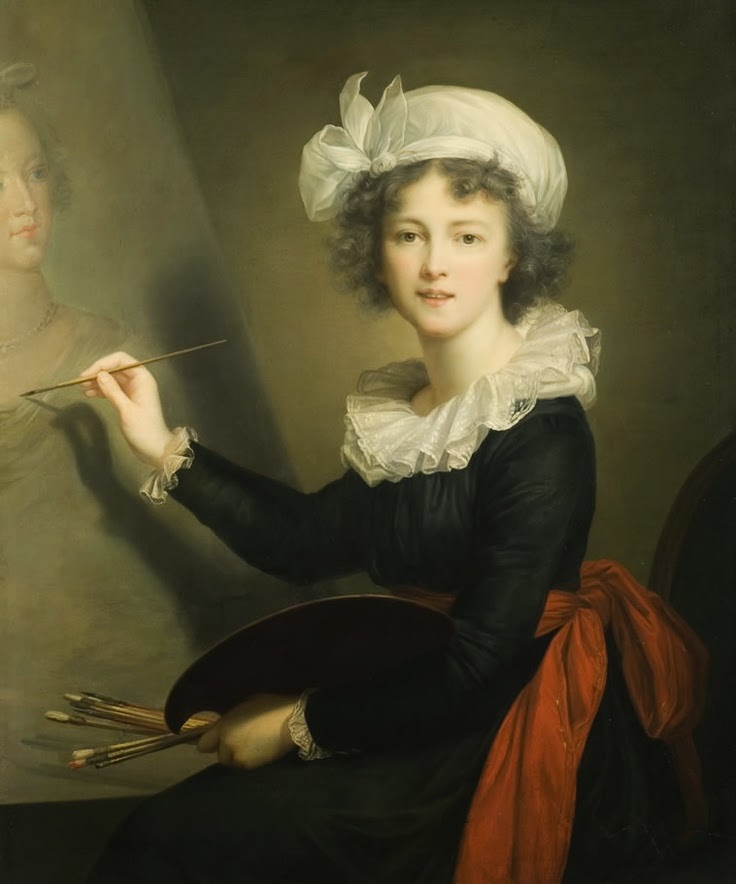
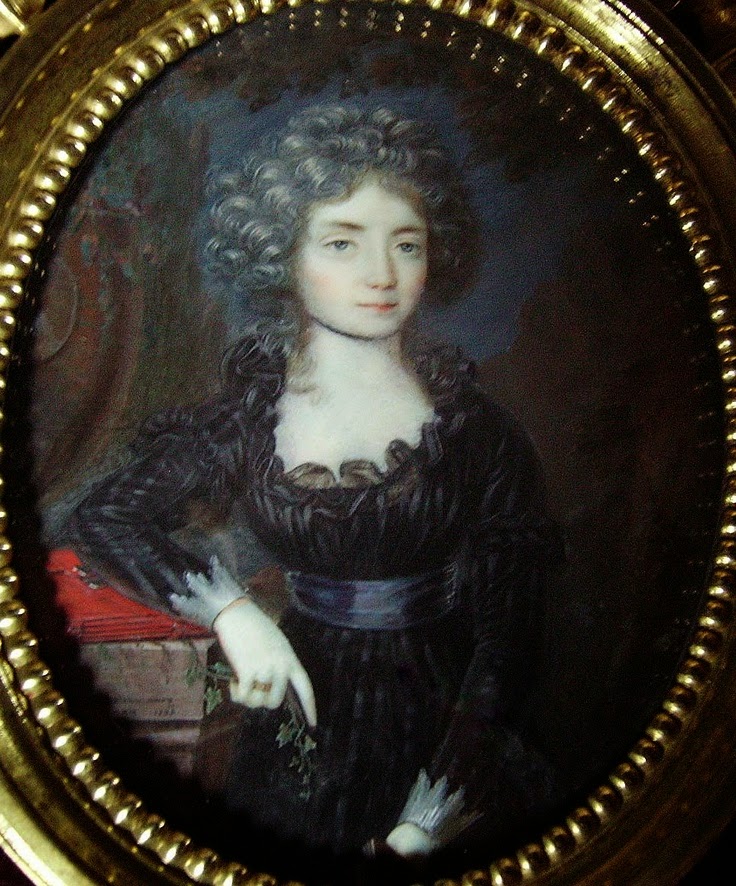
So now I need a black dress that would be appropriate for mourning.  I tossed around a lot of ideas ranging from 1950's to Edwardian to Tudor, but I finally settled into the 18th c. after I stumbled across a few fabulous examples of black chemise dresses.  I had never considered the possibility that chemise dresses could be black, but once I started looking around, I was surprised by how many examples I found of the more somber versions of robes en chemise. It seemed like a really fun choice that is different from the foofy white dresses that you see more often.

My dress is currently taking shape, and I hope to have some progress pictures that I can share in the next few days.  In the meantime, I thought I would show you all some of my favorite black chemise dresses from 18th c. art.  All of these along with links to the original sources can be found on my chemise gown and late 18th c. luv Pinterest boards.  My dress isn't a direct copy of any one style, but I have combined elements from several of these paintings and illustrations to create my own version of a black chemise.


Wednesday, June 27, 2012

Costume Mythbusters: the case of the gaulle

True of False: A gathered-front 18th c. gown with tight sleeves and a fitted back is known as a "gaulle", vs. a gown that is gathered all the way around and has puffy sleeves, which would be known as a "chemise a la reine".

How would you answer?

If you had asked me this question 2 days ago, I would have answered True without hesitation.  I have read this over and over again online from people who know WAY more about 18th c. clothing than I do, so I believed it as fact.  For the past few years, I have been using this distinction myself and teaching other people to do the same thing.

But earlier this week I started wondering how the term gaulle was actually used in the 18th c., and I fell down a rabbit hole of research and historical fashion nerddom.  The specific way that we have been using the word "gualle" - i.e. as a distinct sub-category of the chemise dress with tight sleeves and a fitted back - is without a doubt FALSE.


To unravel this myth, I decided to look though as many different 18th c. fashion journals as I could find to see what people were calling these gowns at the time that they were made.  I found over 40 examples of gathered dresses in 6 different French and German fashion publications from the 1780's and 90's.*  I have posted  most of these fashion plates along with the period words used to describe them on a Pinterest board for easy reference.  These dresses were called a lot of things, but I did not find one single reference to the word gaulle.  I was amazed!

There are other costume historians who are studying the topic of chemise gowns much more thoroughly, and I am sure there is additional information out there that I have missed.  But from my quick survey of online period fashion magazines, here are some of the things that I discovered:

  • The most common name for these type of dresses was "robe en chemise", which would translate simply to "chemise gown" in English.  Other plates were described by more exotic versions of the chemise title, such as "chemise a la Floricourt", "chemise a l'Anglaise", "chemise Grecque", "chemise a la Jesus", or "chemise a la Reine".  Other texts used the word "chemise" alone and simply added a descriptor for the type of fabric or color, like "ein Chemise von weißem Linon" (chemise of white lawn).  
  • Speaking of "chemise a la Reine", I only found this term used three times and in only one publication, and it was used for the earliest incarnations of this type of gown.  These illustrations were published just a few years after Marie Antoinette started wearing chemise dresses in the early 1780's.  At that point, they were still new and trendy garments specifically associated with the queen.  After chemise-style dresses became more common, the "a la Reine" appears to have been dropped.
  • In the very few instances when the word "chemise" was not used for gathered dresses, they usually were described as morning gowns (du matin) or with the term "neglige", which denotes a dress worn in informal situations.  A few others use the word "fourreau", which seems to mean something along the lines of a shift or a sheath dress.  Two plates were listed as "Creole" gowns, and one of those goes on to describe this as a gown worn by Frenchwomen in America, so maybe this type of garment was a popular choice for the heat of New Orleans.  Finally, one example described the gathered bodice as "en rideau", which means it is like a curtain.  But once again, no references to a "gaulle" anywhere.  
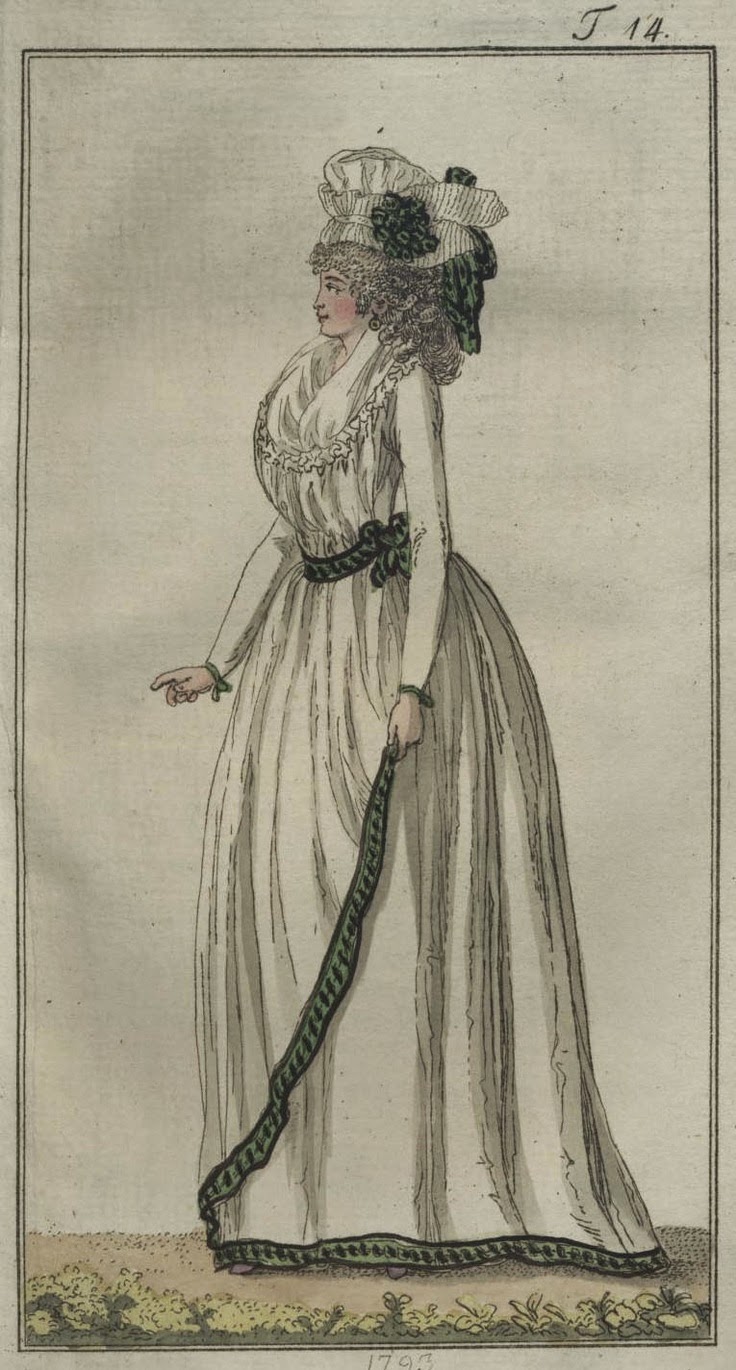
  • I found no distinguishing titles to separate gowns with puffy or tight sleeves, fitted or loose backs, or high or low necklines.  They were all called chemise gowns.  Even in the mid 1790's when the gowns began to morph into new forms with standing collars, deep V-necklines, and were combined with vests or various over-garments, they were still called chemises. 
  • Colored chemise gowns were quite common in fashion plates.  I found examples that were red, pink, peach, yellow, green, blue, purple, grey, and black.  The colors could be muted or very deep.  Colored gowns were listed as being made of muslin, linen, taffeta, and satin, and yet again, they were all referred to as chemise gowns.   
  • Patterned chemise gowns in muslin or silk also existed.  Small dots and stripes were the most common, but I found one example of a chemise gown decorated with stars.   
I have no doubt that the word "gaulle" was used somewhere in 18th c. texts as a creative or exotic title for a chemise dress, but it definitely was not the norm, and it definitely had nothing to do with how fitted the dress was.  And BTW, if anybody knows of an example of the word gaulle used in period literature or fashion plates, I would LOVE to hear from you!  The only example of this word that I could track down was from the painting, Marie Antoinette en Gaulle, which my fabulous art historican friend Sarah from Mode Historique tells me was actually called "la Reine avec chapeau" inVegee-Lebrun's own painting inventories.  It seems that later art historians are the ones who added the term "gaulle" to the title.

But does all of this mean that you shouldn't use the word gaulle anymore?  Well... not necessarily.  You could think of the word "gaulle" like the term "zone gown", which is another modern costume term that was not used in the 18th c.  Neither of these might be historically accurate words, but if historians and costume enthusiasts have agreed to use these words for particular styles of dress, then what's the harm in it?  I just want people to be informed about the historical facts as well, and then you can make an educated choice about whether you prefer to use the modern dress term or the period one.

So now that this myth has been busted, stay tuned to read more about my newest project - a black striped gaulle robe en chemise.


*All of the fashion plates that I used for this survey are found online at these three sources.  If you know of other webbed 18th c. fashion journals that include the original text, please let me know!
Journal des Luxus und der Moden
Bunka Gakuen Library (browse by "History/Age" - there are a number of journals in the 18th c. section)
Gallica copy of Journal de la mode et du goût