Friday, March 30, 2012

the Joanie remodel

So like everybody else on We Sew Retro, I have been bitten by Mad Men fever this month. I didn't even realize that there was a sew-along going on for Mad Men dresses until this past week, but as soon as I caught on to what was going on, I decided that I had to join in on the fun too. So thank-you Julia Bobbin for the inspiration!

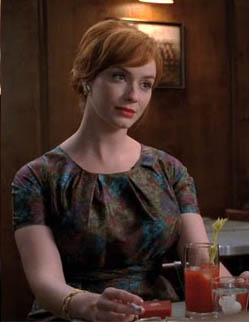
Instead of making a copy of a specific Mad Men dress, I was more inspired by specific fabrics.  One of the $15 estate sale dresses that I picked up a few weeks ago was this mid-century monstrosity.  Although the shape seems like something Betty might wear, the fabric reminded me of a dress that Joan wears in Season 4.  Both fabrics are a mottled mess of turquoise, olive, terracotta brown, and magenta.  It's so wrong, but oh so mid-century modern right!

In its original state, this dress was definitely wearing me more than I was wearing it.  And when I got it home and started looking at it in good light, I realized that all of the magenta and terracotta colored areas of the fabric had discolored to bright purple and blackish-brown on the bodice.  I'm not sure if that was from heat or perspiration or who knows what, but once I realized that, it drove me crazy and I couldn't look at anything else.  Then I discovered that the sewing thread was rotted and the whole dress was splitting at the seams as I was wearing it.  I started wondering why on earth I had bought this silly thing, so I decided that it was safe to put this dress out of its misery and reuse the undamaged skirt fabric for something new and improved. 

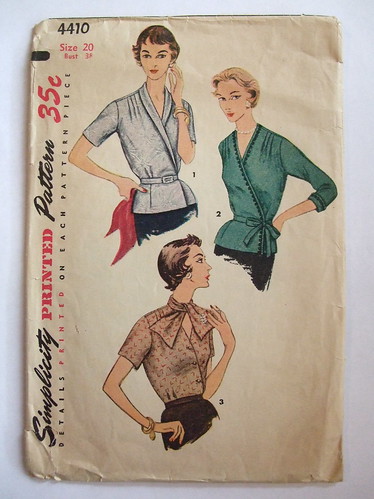
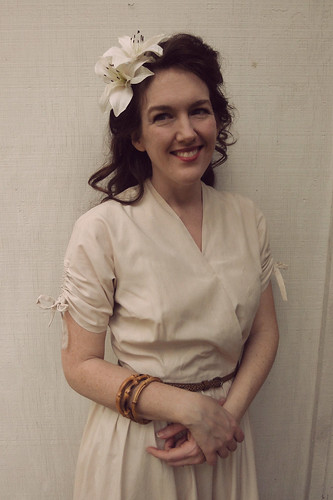
1953 - Simplicity 4410So the skirt of the original dress has now been reincarnated into a wrap blouse using this pattern from 1953.  Although the pattern dates from a decade earlier than the show, Joan wears a wrap blouse in Season 1 so I decided to go with it.  Plus it seemed like a very timeless blouse shape, so I might get away with wearing it in my modern wardrobe from time to time too.


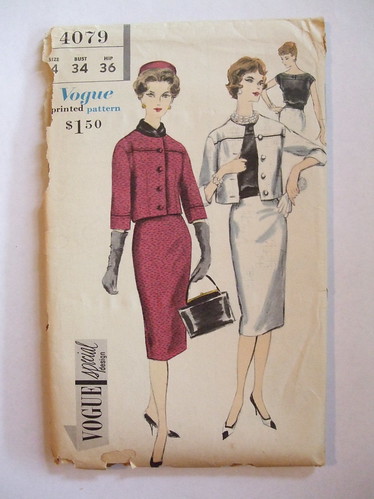
1959 - Vogue 4079The skirt is a very basic pencil skirt made with this Vogue pattern from 1959.  I used some vintage estate sale wool from my stash for the skirt, and I picked this fabric because this type of warm brown is a color that Joan wears often on the show, including in the scene with the wrap blouse.  Although it was a snap to put together, I had to re-sew it 3 times before I could get it tight enough, and I'm still not wearing it anywhere as tight as how Joan wears her clothes!  The skirt pattern also had gathers in the front which made the fabric pooch out in an unattractive way, so I sewed darts in the front where the gathers were.  I really love the way this skirt turned out, and I can't wait to make more blouses to wear with it.

So that's pretty much it!  It was a really fun little diversion, and once again I was amazed by how fast vintage dresses are to make after working on older historical costumes the majority of the time.  This stuff is quite addictive. 


Saturday, March 17, 2012

vintage shopping

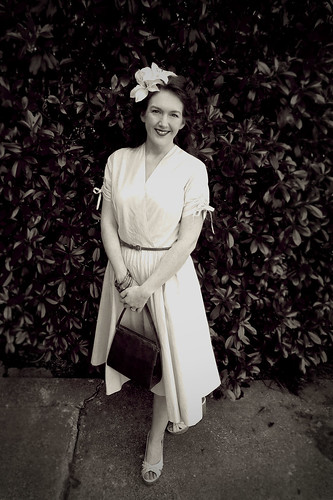
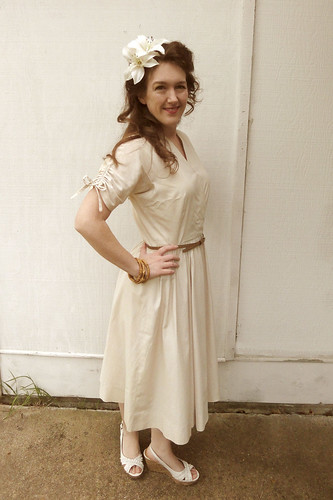
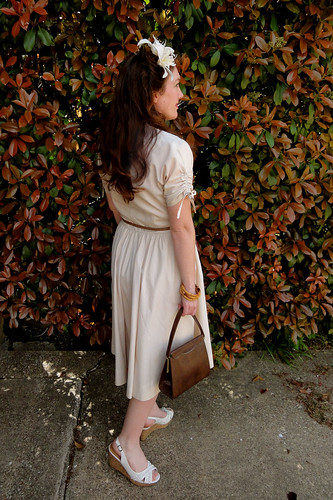
DSC08614Two weeks ago, I ran down to a "going out of business" sale for a Dallas vintage clothing shop.  I could have spent days looking through all their clothes, but I only had an hour or so to spare, so I sped-shopped and came away with with 5 fabulous new vintage dresses... for $60 total!  Woohoo!

This weekend, there was a new Vintage Clothing and Jewelry Show that I was very interested in checking out, so I picked one of my new vintage dressed and headed out for more shopping.  There were a ton of amazing clothes there, but I didn't buy anything this time.  It seemed silly to buy even more dresses when I'm not even sure when I'll get a chance to wear the ones that I just bought.  But I still had a blast at the show and I saw a lot of other ladies wearing fabulous vintage attire, which was a lot of fun.  I'm going to cross my fingers and hope that it comes back again next year!

 And I really enjoyed wearing my new dress. I think it has a very classic shape that doesn't look too terribly "costumey", so I think that this dress this will get a good bit of regular use in my modern wardrobe.  I don't wear dressy outfits very often, but when I do, I LOVE wearing vintage!

DSC08616


DSC08602


DSC08622

Wednesday, March 7, 2012

shews

Okay... I'll admit it. I'm a sucker for a giveaway, and I think I would die of bliss if I won a pair of the new American Duchess shoes... so here I am blogging about it so I can enter the contest.  I plan on buying the ivory version of this shoe when it is released at a later date, but I sure wouldn't mind a pair of the red ones too just for fun.
*le sigh*

Sunday, February 19, 2012

Winter of the White Dress

DSC08179

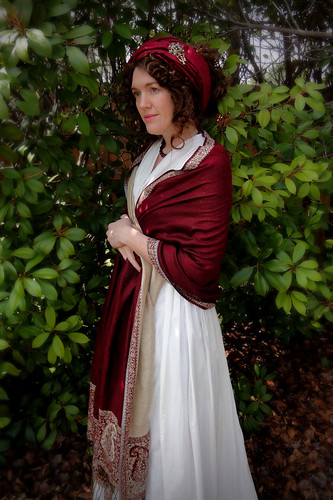
This weekend was the Antique Elegance Show, and I ended up wearing my white 1790's round gown for the 3rd time in 4 months.  I think that's a new record for me since I usually hate to repeat costumes.  But each time I've worn it in a slightly different way, which is one of the most wonderful things about Regency dresses - they are so versatile!


This time, I wore the dress alone with just a silk sash wrapped around my waist and shoulders in a way that is similar to these illustrations.  I've read that this revolutionary fad was known as croisures à la victime, making a symbolic "x-marks the spot" on a woman's back.

 I'm not sure if this is true or just a fashion myth, but here's an interesting webpage about it.

I also wore my new-and-improved paisley shawl.  After I wore it last month, I decided to buy a second shawl that was the same as the first and sew them together to make one super-long shawl, which is much more appropriate for this era. I'm so much happier with it now, and it might be my new favorite accessory ever.  I also wore my turban from the first wearing of this dress, but I left off the wheat spray so I wouldn't be as likely to knock things over with my crazy headwear in the booths while shopping.

I didn't buy very much this time at the show, but I had fun hanging out with some friends, lusting over the gorgeous fur muffs and seeing all the antique dresses. And as always, it was wonderful to have an excuse to dress up.  Here are a few more pictures of my dress just for the heck of it.

DSC08185


DSC08196

Saturday, February 11, 2012

DIY spats pattern


The 1890's cycling costume that I'm working on right now shows off a bit of leg, so I need to pay more attention to my footwear than normal.  I usually just wear a pair of black pumps and black stockings with my Victorian costumes, but I decided to make myself a pair or tall spats, also known as gaiters, for this costume.  I actually have a period pattern for knee-high gaiters taken from a Victorian fashion magazine, but I've discovered from previous attempts to make them that my ankles and feet are way too big to fit the pattern very well.  So instead of making a lot of alterations to that pattern, I thought it might be fun to show you haw to make your very own spats pattern.  These work great with steampunk and neo-Victorian outfits too if you are not into the historical costuming thing.
Step 1: Figure out what shoes you are going to wear with you spats or gaiters.  Basic pumps with a high vamp work the best, but spats cover a world of shoe flaws, so you could make these to go with a lot of different styles.  Bonus points if you can find some pumps with spool heels.  Put on one shoe, then find a sacrificial pair of stockings and cut it off at the thigh.  Put the stocking on OVER your shoe.


Step 2: Get some duct tape and start wrapping it around your leg.  Start at the ankle first, then work your way up.  DO NOT pull the tape too tight so that it squeezes the flesh in your leg.  You just want it to be snug and fit smoothly - not reshape anything.  I prefer to use smaller cuts of tape that don't even reach all the way around my leg because there is less wrinkling that way.  Since most of your leg is shaped like a cone vs. a tube, it helps to angle your tape diagonally instead of trying to wrap it in perfectly horizontal rings.  Switch directions with the tape and layer the pieces until you cover the entire surface of your calf (or however high you want your spats/gaiters to go).

Step 3: Next, you will start covering the foot with tape, but leave the ankle alone for now.  Start by creating an anchoring strip that wraps around the entire foot at the instep. This keeps the stocking from shifting around on your foot while you work.  Continue covering the top and sides of the foot with smaller pieces of tape going whichever direction will give you the flattest surface.  You don't need a ton of layers, but try to make sure that your foot is covered with 2 layers in most areas to make sure the tape doesn't stretch or slide.  You don't have to worry about covering the toes or the sole since these areas are not included in the spats.


Step 4:  Start filling in the area between the ankle and the leg.  Try to use an X pattern with the tape to cover the larger spaces, then fill in the gaps with smaller cuts of tape.  Don't be afraid to cut narrower strips if that helps - especially for the front or back of the ankle where the curve of the foot is the most extreme.   Make sure you are standing or at least have your leg at a right angle to the floor for this step or else your finished spats won't fit right.  Once you get the ankle covered, try not to walk around anymore since it will cause wrinkling in the tape if you bend your foot too much, and that makes it more difficult to trace an accurate pattern.


Step 5:  The heel is one of the trickiest parts to cover since it is so round.  I wrapped a single piece of tape around the back then snipped the tape every inch or so and overlapped the cut edges to make it lay flat over the curve.   You could also cut narrower pieces of tape to cover the heel since the smaller the tape is, the less it will wrinkle.  It doesn't have to be PERFECTLY flat, but you just don't want large wrinkles or places where the tape gapes away from your foot.


Step 6: You now have a fully wrapped leg. Hooray! Take a sharpie and draw a line down the middle of your leg in the center-front and center-back. If you have somebody who can do this for you, it is a huge help. If you don't have anybody there, all you really need is the center-front line, and then you can draw in the rest once it is off your foot.


Step 7: With a pair of sharp scissors, cut the tape and stocking down the center front line. Once you get past your ankle, you should be able to slip the entire thing off, and then you can put you hand inside of the taped form so that you can better guide your scissors to make sure you don't cut your shoe. I also recommend marking the opening of your shoe on the tape before you cut it off so that you are sure that you spat or gaiter is big enough to cover the edges of your shoe. I couldn't feel the edge of my shoe through the tape while it was one me, so I had to wait until I could remove my foot and then I could feel the edge and trace it.

If you didn't do this while the form was still on your body, draw a line down the outside of the leg for the button opening. I started drawing this opening like Victorian button boots where the edge curves to the front of the foot, but then I looked up some pictures of tall spats, and I realized that this line should be straight and end between the heel and the buckle that holds the spat on your foot. I corrected this before I cut it out. You will also need to draw the shape that you want the bottom and top edges to be. Some period spats had a little dip where the strap that goes under your foot attaches, but others are smooth all the way around the bottom.

Step 8: Cut your tape pattern along the center back and side button lines and lay the pieces out on paper. The tape pieces will probably not lay completely flat, but smooth them out as much as you can and trace around the pieces. You will need to add an underlap on the side opening for the buttons, and a seam allowance to the center front and center back seams. If you are making your spats out of a fabric that frays, you will also need to add seam allowance to the top and bottom edges unless you are going to use some type of binding for the edges.

BTW, I ended up with a curve in my pattern when I cut the button opening line down the side of the leg.  I haven't noticed this shape in period spats - it is usually very straight.  I'm not sure if I am going to keep it curvy or try to straighten the edge out some more.

Step 9: Make a mockup and try on your gaiters or spats.  I made my mockup out of craft felt, but anything sturdy like thick denim or upholstery fabric would also work great.  Pin them closed on the side, then mark any areas that need adjustments.  On my gaiters, I had to take out some of the curve over the calf, and I also tweaked the shape of the flap over the foot a bit.  Transfer your adjustments back to the paper pattern, and if necessary, make a 2nd mockup to test your changes.


Congratulations!  You now have a custom pattern for Victorian or Edwardian spats!

Traditionally, spats and gaiters were made out of wool felt, leather, or canvas, but you could also make them out of other types of fabric.  And if you didn't want them to button up the sides, lacing or buckles would do the trick nicely as well.  At this point, I need to go buy some fabric and buttons, but then I hope to come back with Part 2 of this tutorial to tell you how to construct your fabulous footwear.

Wednesday, February 8, 2012

Cycling costume, take 2

So after letting the mid-1890's jacket sit in the naughty pile for a few weeks, I finally decided to put it on indefinite hold and focus on something easier for our upcoming Steampunk event.  This is an incredibly busy time of year for me, and while I think the jacket could still be amazing if done right, I don't think I have the time or patience for all that tailoring right now.

I'm still going to make an 1890's cycling costume though - but this time it will be a blouse and skirt.  Once again, I made a Pinterest board of inspiration pics to get me started.  There are some amazing outfits there, but I was most attracted to the look of a calf-length skirt and a plaid or striped blouse:


Source: oldbike.eu via Jennifer on Pinterest


Source: oldbike.eu via Jennifer on Pinterest


So now that I have a plan, the next step is to come up with a pattern.  I pulled out my two Kristina Harris books on 1890's patterns, and I found a blouse from 1894 that I liked.  I used my trusty apportioning scales from the Edwardian Modiste book to enlarge the pattern (technique previously blogged about here), and once again, it fit great with just a few tiny alterations.  But I wasn't crazy about the huge sleeves in this pattern, so I decided to exchange them with a different style.  Seven sleeves later, and I think we have a winner!   LOL!  But honestly, I was having a blast drawing up these patterns and testing them out, and I thought it would be useful for both me and others to see a variety of sleeve styles from these books in the flesh.  By the way, I'm abbreviating the book titles to AVFP for Authentic Victorian Fashion Patterns and 59ATCFP for for 59 Authentic Turn-of-the-Century Fashion Patterns.  So here are my options:

1. Small sleeve puff, 1893, AVFP p. 32
Before I started making these patterns, I thought this would be my favorite.  I still think the sleeve is cute, but it is smaller than I thought it would be, and I think it works better as a double puff like you see in the illustration.  The puff could easily be altered to be larger if I wanted to do that, but I think I would prefer to stick closely to the original patterns for this project.  In this picture, I'm wearing the puff part with a tight fitting sleeve lining that comes with a lot of the leg-o-mutton patterns.

2. Medium sleeve puff, 1893, AVFP p. 92
After seeing that the first puff was too small, I thought that this one would be a perfect fit, but I was pretty unhappy with the way it made up.  The sleeve puff seemed much more rounded in the illustration, and mine is annoyingly long and flat.  Again, I could add more width on my own, but I thought I'd try the next size up and see how I liked that.

3. LARGE sleeve puff, 1894, AVFP p. 99
OMG what a difference a year makes!  These Belle Epoque ladies were not messing around when it came to sleeves!  This is the pattern that I am using for my bodice, so I figured that I might as well try the larger sized puff while I was at it, but now I feel like I'm being eaten alive by my sleeve.  And this is a little limp too - imagine what it would be like with stuffing and that extra ruffle on top.  Madness! 

Unfortunately, there is no in-between size to bridge the gap between the too-small medium puff and the gargantuan large puff in these books.  There is one sleeve style with a double puff that might be less ostentatious, but I really didn't want a double puff for this particular outfit, so I didn't bother to make that one up.

4. Sleeve for a stout woman, 1893, 59ATCFP p. 79
So now that I exhausted my straight-from-the-pattern puff sleeve options, I decide to try some leg-o-mutton styles.  This one was disappointingly small compared to the illustration.  It was slightly wider that the sleeve lining that I had been using with the puff sleeves, but there wasn't a lot of fullness at the top.  It looked like a sleeve from the early 90's vs. the mid 90's, which probably makes sense since a lot of the stout patterns are intended for older women who are less likely to follow the latest trends.  And BTW, this sleeve pattern was designed for women with a 36" bust or larger, so their definition of "stout" should be taken with a grain of salt. 

5. Wrinkled muttonleg, 1893, 59ATCFP p. 66
The illustration for this one looked like a hot mess, but I was pleasantly surprised by the way that it turned out in the flesh.  The sleeve-head has obvious fullness without being ridiculously huge, and there is some gathering down the length of the arm which gives it some interesting horizontal wrinkles in addition to the fullness at the top.  I really liked this one, but while I was on a roll, I thought that I would try two more mutton styles to see how they compare.

6. Balloon sleeve, 1893, 59ATCFP p. 54
The illustration for this sleeve looked like it wasn't much bigger than the wrinkled muttonleg, but the real sleeve is actually quite large.  It is just as wide as the mutton leg sleeve shown below, but it's even taller so it drapes more.  This is a perfect example of how deceptive the fashion drawings can be.  I don't hate this one, but it is so floppy that I'm afraid that I'd be constantly fussing with all that extra fabric to get it to flop in an attractive manner.

7. Mutton leg sleeve, 1894, AVFP p. 57
I wasn't planning on making this one up since the illustration makes it look MASSIVE, but after I realized that it was smaller than the balloon sleeve, I thought I'd give it a try.  There's nothing wrong with this sleeve, and I think if I tightened up the forearm a little it would be pretty cute.  Even though I don't think I'll use it for my blouse, I'm glad I tried it.  I've never been a big fan of the huge 1890's sleeves, but this actually wasn't as bad as I thought it would be.  

So now after seeing my 7 options, I think I like #5, the wrinkled muttonleg, the best, which was totally a surprise for me.  But I think it strikes a nice balance between being too big and too small, and the unusual method of gathering gives it some nice visual interest.  And as a bonus, I think it looks very similar to the charming blouse seen in this illustration.  Now on to the real sewing!
Source: oldbike.eu via Jennifer on Pinterest


Sunday, January 29, 2012

the "oh crap" moment

Have you ever had that feeling when you try on a project for the first time and you discover that the absolutely perfect costume plan that you've had in your head for months and months is nowhere near as perfect in reality?  Unfortunately, I had one of those horrible "oh crap" moments today.

This March, the DFWCG is having a steampunk tea party, and my plan was to make a super fabulous 1890's cycling costume based on this:


I found the perfect pattern for the jacket in 59 Authentic Turn of the Century Patterns, and I used my nifty apportioning scales to enlarge it to my size this week.  The enlarging went pretty well for the bodice.  The fit through the body is great, and all I would need to do is adjust the darts a little.  The back collar piece was slightly too big, but it would be an easy fix.  The sleeve, on the other hand, was WAY too big, which happens fairly often when you are enlarging one of these patterns that uses the bust measurement ruler for everything.  I could go back and try to draft another one with a smaller scale, or I could just alter the sleeve that I have to make it fit better.  I am not overly fond of the pleating pattern this sleeve uses, but again, I could change that with no problem.  I also messed up and used the bust scale instead of the waist scale for the skirt of the bodice, so it was way too big and I will definitely need to redraft that if I decide to move forward.

So the pattern is working fine, but here's the problem.  I underestimated the amount of effort it is going to take to tailor this thing correctly.  The lapels and collar are going to take a MASSIVE amount of pad stitching and stiffening to make them lay right.  And I honestly have no idea how to get the sleeves to poof out enough that they won't look sad and limp.  There is obviously some major engineering going on in a jacket like this, and I'm not 100% sure that my skills are up for the task.

Of course, I shouldn't judge a project too harshly based on the first mockup, but I tried my muslin on today and all I could think was "meh".  It makes me feel top-heavy and even with all the weight that I've lost this past year, I'm still not sure that my waist is small enough to offset the poofiness in this outfit.  Plus, the thought of all that tailoring is daunting to say the least.

I just don't know.  Maybe I'll put it aside for a week or two and let it ferment.  I don't have a plan B costume for this event, and I've already bought all the fabric for the cycling suit, so I sort of feel obligated to push on through.  What do you do when you discover that you are no longer in love with a costume that you were once super-excited about?  Continue anyway?  Find something else and not waste your time and energy on something you no longer love?  I usually try to keep going no matter what, but the results of that have been mixed in the past.  Sometimes I'm happy with the final results and I'm grateful that I didn't give up, and sometimes I waste weeks or months on something that I ultimately hate and often never finish anyway.   Maybe I should try a different plan this time and cut my losses now and start looking for another costume idea.

We'll see...

Friday, January 20, 2012

pattern drafting with apportioning scales

A lot of people seem to be intimidated by the pattern diagrams in the Frances Grimble books that use apportioning scales to help you enlarge the patterns.  This technique uses special rulers that allow you to draw out the pattern in your own unique size for a custom fit.  Once you get the gist of how it works, this technique requires almost no math and very little thinking.   I *LOVE* using this type of pattern, and I've had really great results with the dresses that I have tried in the past, so I thought I would make some video tutorials to show you all how easy they really are to use. Please excuse my choppy endings. My video editor refused to work with these files, so they are pretty rough around the edges.

The first video talks about how to select the correct apportioning rulers based on your own personal measurements.


The next video walks you through the process of drawing a pattern piece with your custom rulers.


Important things to note:

1.  The apportioning rulers in the Edwardian Modiste book can also be used for Kristina Harris's books of 1890's dress patterns (links to all below).  Harris doesn't include the apportioning rulers in her books, so this is a huge help if you want to use her patterns!
2. The Grimble and Harris books that use pattern systems from the 1880's and 1890's only use the bust measurement ruler for everything that you draw, including the sleeves.  But the system used in the Edwardian Modiste is slightly different, and there is a somewhat complicated way that you are supposed to measure your arm length.  Finding this sleeve length measurement is probably the most difficult step of the entire pattern drafting process, but there is a description of how to measure your arm length on pages 7-8 of the Edwardian Modiste.  You then use your arm length for the vertical measurements in the sleeve pieces (just like we used the waist length for the bodice), while the bust measurement ruler is still used for the width of the sleeve pieces.  Grimble advises that you can also use the modern technique for measuring your sleeve length (simply measuring from shoulder to wrist), and this will get you close enough.  I haven't tried either of these methods with the Edwardian Modiste patterns, but I'll let you know when I do.
3. As I mentioned in the video, skirts are drafted with a different set of rulers from the bodice.  You use your waist measurement for all the horizontal lines (i.e. the 28" ruler if you have a 28" waist). For the main vertical line, you measure from the waist to the floor to determine the length of your skirt, and then select the ruler with that measurement for the vertical baseline on your pattern (i.e. use the 41" ruler if you want your skirt to be 41" long).
4. For dresses with the bodice and skirt all in one, you will use your waist length ruler for the vertical line on the bodice section, and the skirt length ruler for the vertical line on the skirt.
5.  Be warned that the hips on these patterns will probably be too large for most modern figures, but you can always take them in if you need to on the muslin.
6. Even when seam allowances are not marked on the pattern pieces, they sometimes ARE included on the patterns.  The armscye is a good example of this - you might not need to add selvage to the armscye and sleeve-head on some patterns.  But you won't know for sure if you need the extra fabric or not until you make the pattern up, so it is better to add seam allowances just in case.  You can always cut them back off if you find that you don't need them.
7. The type of corset that you are wearing is very important when selecting the proper rulers.  The waist position on my Edwardian corset is much higher than it is on my Victorian corset.  If I am wearing the wrong corset (or none at all) when I measure my back length from my neck to my waist, it will completely throw off the fit of your garment - especially on these late Edwardian patterns where the waistline is intended to be relatively high.

Well, I hope this was helpful!  Let me know if you have any questions on any of this.  I am actually more familiar with using the apportioning systems in the Fashions of the Gilded Age and the Harris books, but I know that the Edwardian stuff is the most popular right now.  But all of the systems are very similar, so once you get one under your belt, the rest are much easier.  Now go forth and draft fabulous patterns! :)

(P.S. - if you would like to buy one of these books that uses apportioning rulers to draft patterns, feel free to use one of these links and I will get a little bitty contribution to my book fund. Thanks!)

Sunday, January 15, 2012

Mat Hatter costume

DSC07694

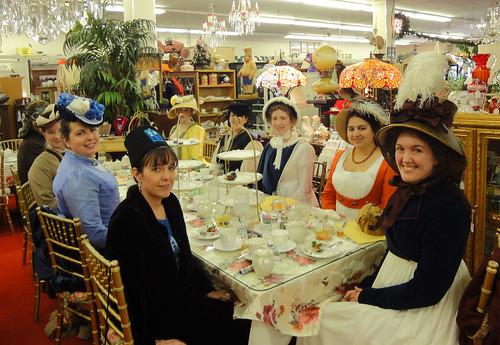
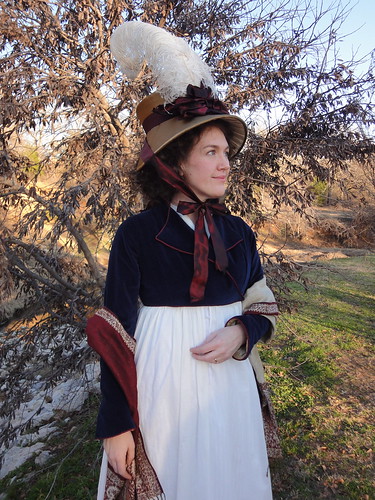
Yesterday was the DFWCG's Mat Hatters Tea Party, so I wanted an appropriately flamboyant hat (and new costume to wear with it) to celebrate the event.  I've spent the past 2 months angsting about what to make, and I think I started working on at least 3 or 4 other possibilities before I finally settled on a simple 1790's spencer and bonnet.  But I ended up loving the final outfit so much that now I can't imagine wearing anything else!

DSC07762

To save time, I focused on making something new to dress up my round gown that I made for the Georgian Picnic in November.  I didn't know a lot about Empire spencers, so I started by creating a Pinterest board of all the 1790's examples that I could find.  I was amazed by how many dark blue spencers there were in the illustrations, so I went digging through my stash and found a dark blue velveteen curtain panel that I picked up at an estate sale last year.  It was just enough fabric for a spencer, so I decided that it must be fate!  It is lined with some golden yellow striped silk that also came from my stash, and I even found some burgundy cording in my bin of ribbons that was perfect for accenting the edges and back seams like you see in many of the jackets from this period.

I usually have some sort of period pattern diagram to get me started with my costumes, but this garment was 100% draped from scratch.  I knew where the seams should be thanks to the illustrations and a few surviving examples, so I used one of my paper tape dress forms to drape the body and collar.  I did look at a pattern diagram for an 1790's youth's skeleton suit to get the general shape for the 2-part curved sleeves, but then I just free drew the shapes and tweaked them for a few days until I got something that fit just right.  I know it is not an overly complicated garment to make, and there are still a few nit-picky things that could be improved, but I am really proud of the results considering that this was the first time for me to make something using this method.

DSC07766

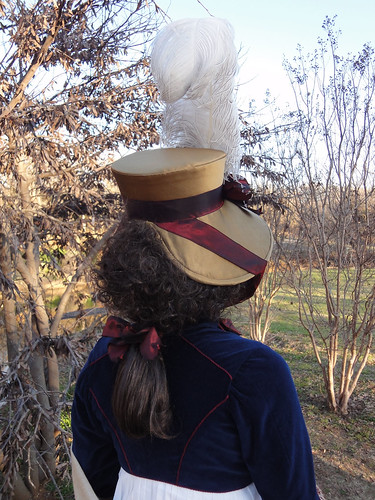
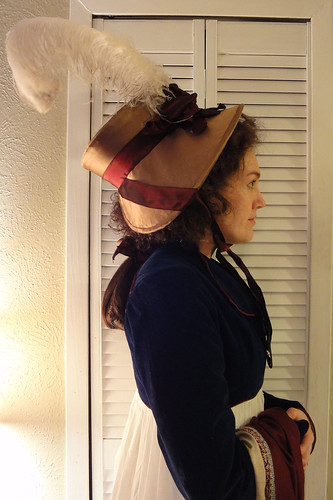
The most fun part of this outfit is definitely the hat. Once again, I made a Pinterest board to help me research 1790's bonnets, which was extremely helpful when it came down to deciding on the shape and adding the decorations.  I found several examples of wide brimmed bonnets with a big bow and super-tall feathers decorating the middle front of the crown, and I thought that look really captured the quirky Empire style that set these fashions apart from other Regency period headwear.

The bonnet also marks another first for me - it's the first time I've ever built a fabric-covered buckram hat.  I used Lynn McMaster's seaside bonnet pattern to make it, but I cut the crown down by an inch because I preferred some of the more moderate-sized examples in the fashion plates.  It is covered in a remnant of bronze silk satin and lined with ivory silk, which also both came from my stash.  I sewed the entire thing by hand and there is not a drop of hot glue on it, which is a small miracle for me.  I am usually a HUGE fan of hot glue millinery!

DSC07810

Since the costume was made completely from materials that I had in my stash, I decided to splurge a bit on the finishing touches.  I bought another Lioness wig in chestnut brown this time (I also used this style of wig for another 18th c. outfit from a few years ago).  It is great for making a huge hedgehog style hairdo and there is a ton of length for various types of tails in the back as well. This time I straightened the long part in the back with a flat iron and looped it like the style seen in many illustrations from this period.  I had some flyaway pieces that tried to escape from the ponytail at first, but I added a long flat barrette across the back of the loop after these first pictures, and that seemed to solve the problem pretty well.

DSC07640 DSC07646

I also have lusted over regency shawls for years now, so I asked around for suggestions on where to buy one.  My friend Aubry from A Fractured Fairytale suggested this ebay store, which has a variety of rectangular shawls with paisley borders, which is exactly what I was looking for. It still wasn't as long as real regency shawls should be, but at $19.99 I couldn't pass it up! I actually ended up loving this thing so much that I bought a second one that is exactly the same, and I am going to try to sew two of them together to make one super-long shawl that will be even more perfect for drapey Regency goodness.

DSC07812

DSC07768When I was younger, I didn't care for Regency fashions at all, and I swore that I would never wear this sort of dress. I'm not sure what happened, but I've turned into a complete convert and I feel so elegant wearing these styles now. Maybe I just needed to get over my obsession with tiny waistlines first, but I guess pregnancy will do that for you.

Even though I'm making a bit of a funny face in this last picture, it's actually my favorite one of all. I think I look like a meddling, match-making aunt from a Jane Austen novel in this shot.  I need a little speech bubble that says "oh, ree-aaally?" LOL!

You can see the full set of pictures from this wonderfully fun event on my Flickr page.