Saturday, August 4, 2012

Mourning Party

DSC00468
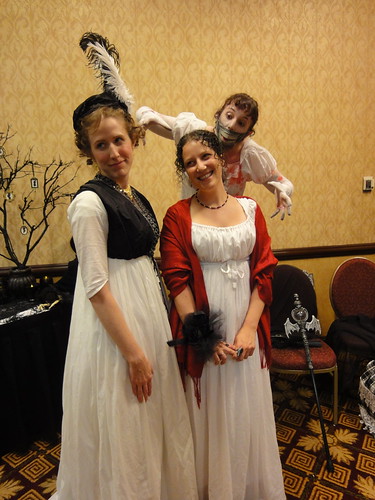
Regency zombie photo bomb!

The highlight of the Costumer's Lost Weekend for me was the Mourning Party. This was the one part of the event that I was in charge of planning, and I had a crazy amount of fun working with my fellow guild members to come up with ideas and make all the delightfully morbid decorations for the party.
DSC00320

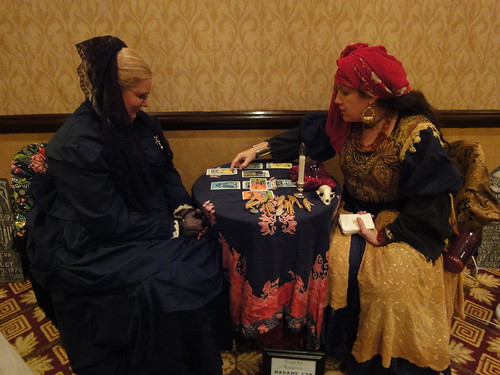
We drew inspiration from Victorian Spiritualism for some of our activities, so we had our very own fortune teller, the Mysterious Madame Cyn (wwooooOOOOooooo!!!), who would do readings for our partygoers. I was so busy with other things that I never got a reading myself, and I am totally brokenhearted about that, but everybody else seemed to really love it. Hopefully I'll get another chance to consult with our official Guild Gypsy at some point in the future.
DSC00397
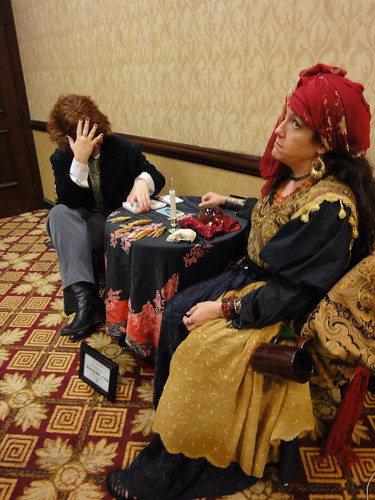
Oh no - trouble in the future?

Christy and Lesa

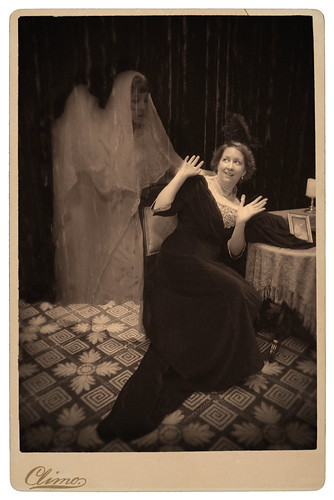
We also set up a photo booth and had a ball taking some of our own Victorian-style ghost and mourning photos. I'll post more on this later today - there are just too many great pics to show you all of them here!
DSC00413

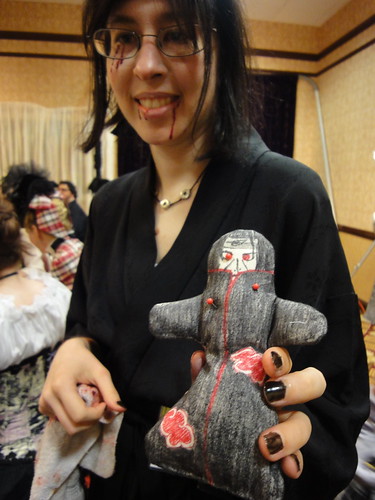
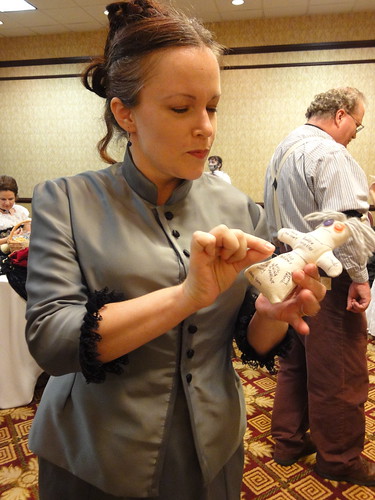
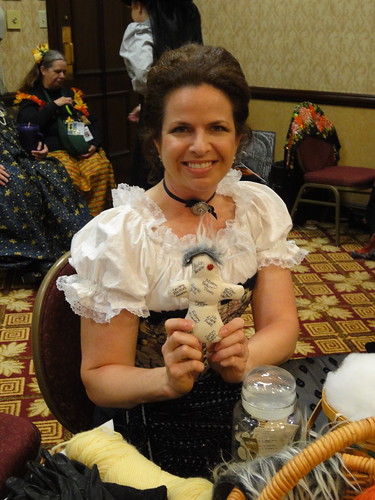
In the middle of the room, we had a table set up for people to make their own costumer voodoo doll pincushions. We labeled the dolls with our worst sewing demons, like "sleevils", "missing pattern pieces", "wonky hems", etc. Hopefully, we now can stab these pesky problems with pins and drive the bad sewing juju away! Some of the dolls were absolutely hilarious - I wish I had taken pictures of them all!
DSC00437

DSC00442

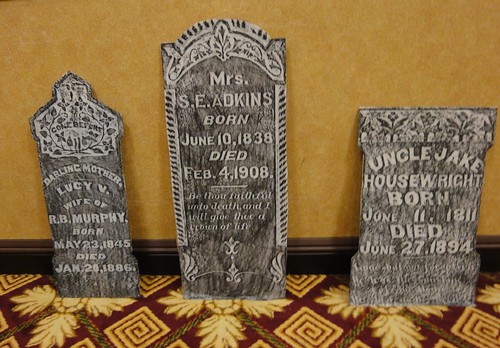
For the party decorations, I went to a cemetery and did a bunch of tombstone rubbings, which was such fun little project!  You can barely see them in the photos since we weren't allowed to hang them on the walls, but they made me happy, and hopefully they added a little to our mourning atmosphere.
DSC00540

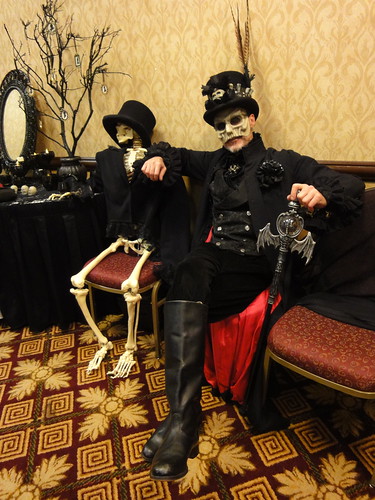
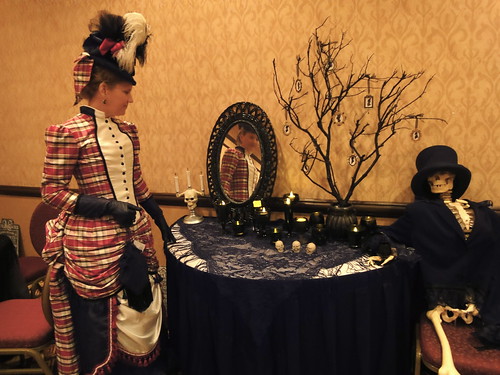
I also made a bunch of miniature silhouettes to hang from a dead tree centerpiece, which was another fun project that you can't really see much of in these photos.  The rest of the decorations mostly came from candles, spray-painting a lot of random decorative junk black, and lots of creative draping of black fabric everywhere.  Oh yeah, and one FABULOUS skeleton chaperone to keep an eye on the party!  
DSC00362


DSC00440

I had so much fun at the party and time went WAY too fast!  I really wish I could rewind the evening and do it all over again.
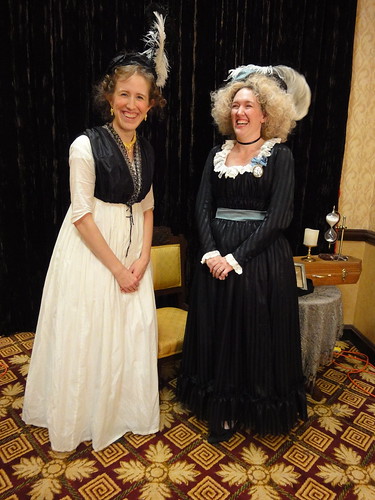
DSC00529
As you can see, I fail at mourning poses!  


To be continued...

Friday, August 3, 2012

Costumer's Lost Weekend, pt. 1

DSC00307

Last weekend was the DFWCG's first overnight event - the Costumer's Lost Weekend. We are still a relatively small group, but I think our first try at a hosting a mini-con was a great success, and all the hard work that we've done over the last 6 months really paid off. I thought I would give a little recap of the weekend here to show you what our Lost Weekend (or CoLoW, as I've been calling it) was all about.

DSC00296
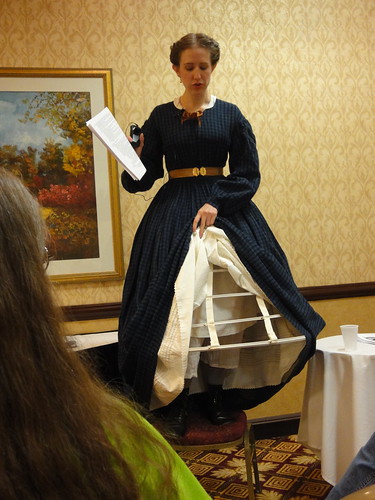
On Saturday during the day, we had a series of 7 classes covering a range of topics on historical and fantasy costuming. Unfortunately, I had to miss several of the classes during the day so I could work on some last minute preparations for the party that night, but the classes that I did attend were great! Two of my favorites were taught by my friend Ginger from the blog Scene in the Past.  She explored the topics of working with vintage patterns and Civil War costuming.  I picked up some great ideas from both of these classes, and the vintage pattern class especially got me in the mood to work on some new retro frocks.

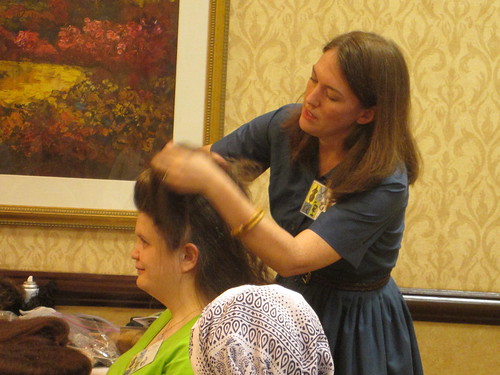
I also taught a class on big Edwardian hair, and it was a blast to teach!  I talked about the range of hairpieces that were available in the period, how to make your own hairpieces with modern materials, and then I attempted to style 4 different Edwardian 'dos on some brave volunteers from the audience.  I learned two main things from this experience:  1) I talk A LOT and need more than an hour for a class, and 2) styling hair without lots of hairspray and teasing is very very hard!  LOL!    

IMG_5395
After the classes were over, we broke for a 3 hour dinner break, and I was amazed by how many people stuck around to help set up the room for the party that night.  We have such wonderful folks in our guild!  After our flash mob decorating, we then started getting dressed for the evening and had a fun little pizza party back in the hotel room.  I think my favorite part of the whole weekend was getting to make some new friends and getting to know some old friends even better, so I especially enjoyed the moments like this where we could just relax and be silly and have fun together.

DSC00308

To be continued...
Tuesday, July 24, 2012

shoe make-over


My new black chemise dress is pretty simple, so I wanted something more over-the-top for the accessories. I bought these vintage shoes on Etsy earlier this year, and while they were already a fairly decent faux-18th c. style, I thought they could still look better. So I found an example of some buckle-less late 18th c. shoes and used this as my design inspiration. I cut off the bow and the fake tongue piece on my shoes and then box pleated some ribbon to cover the modern looking gimp trim. Then I just added my own satin bows to match the new ribbon trim and they were done!  Although they are still way more theatrical than authentic, I think they look a little less 1980's-ish this way. I could probably press the box pleats to make the trim look a little more like the inspiration shoes, but I kind of like them being a bit silly and frilly.   Plus, they remind me of some of the fabulous shoes from the movie Marie Antoinette.


Monday, July 23, 2012

black chemise - sneak peek


DSC00123
DSC00143

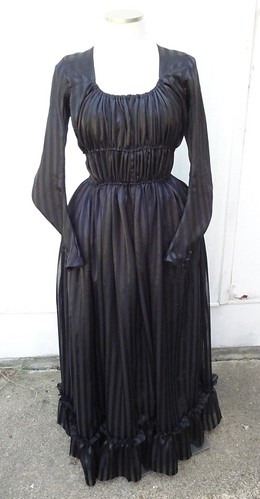
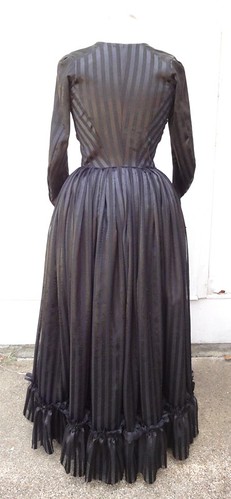
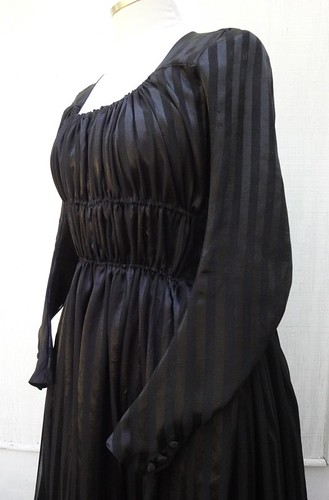
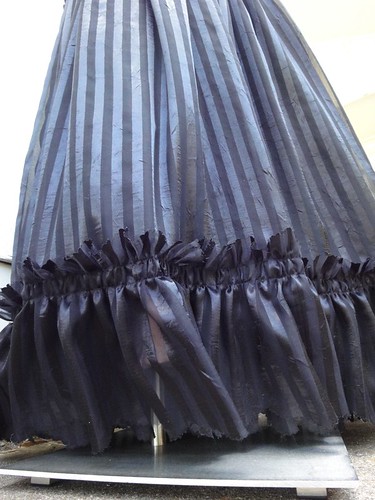
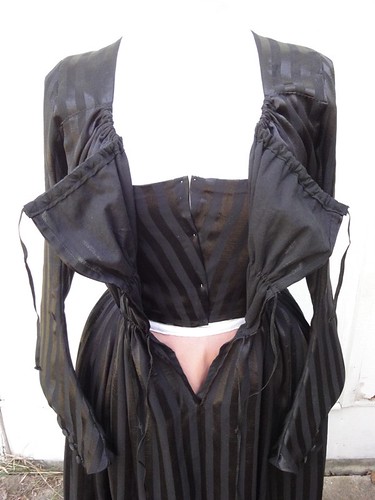
I finished my black chemise gown yesterday, so I decided to put it on a manikin and share a few pics showing the construction.   It is so hard to see details on an all black dress in most photos, so I have adjusted the exposure so you can see everything more clearly.

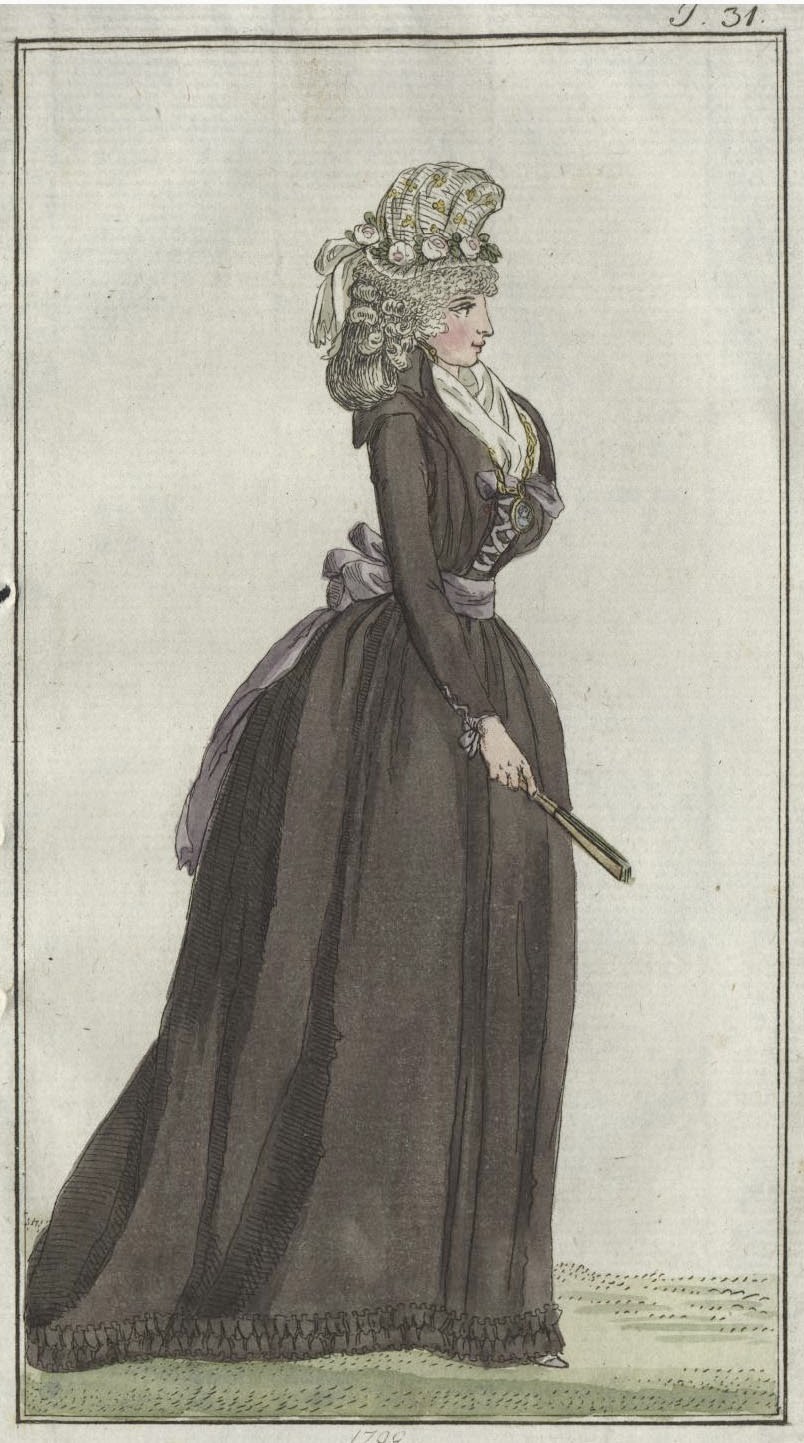
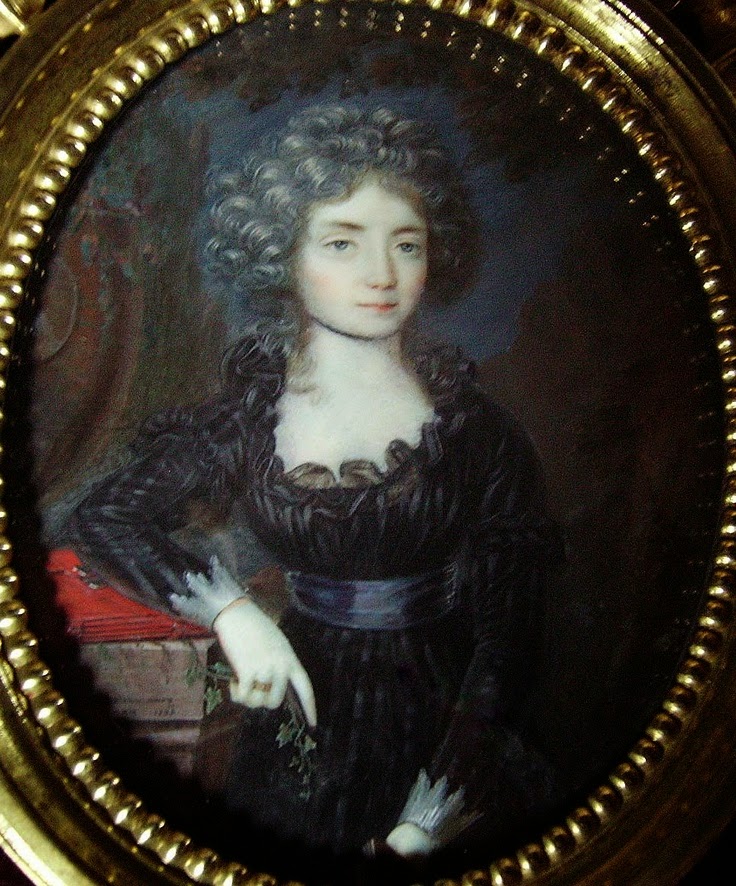
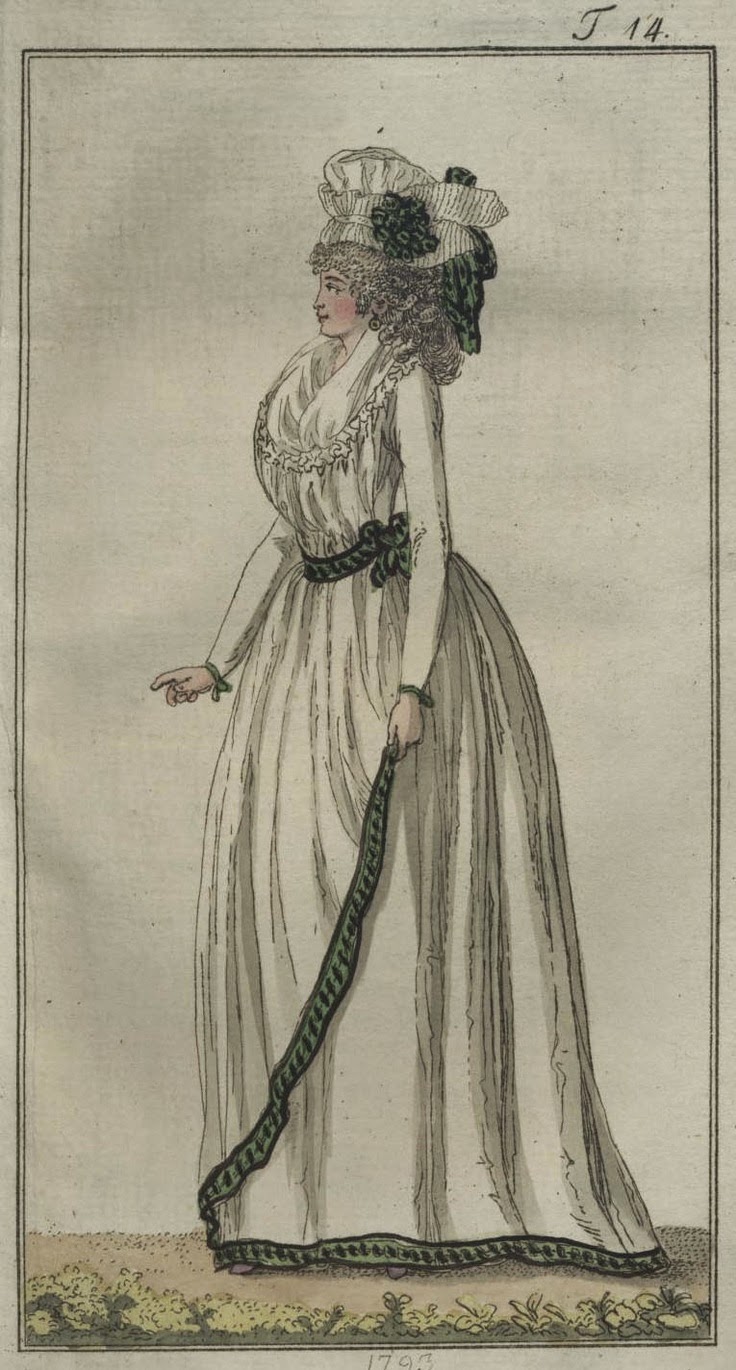
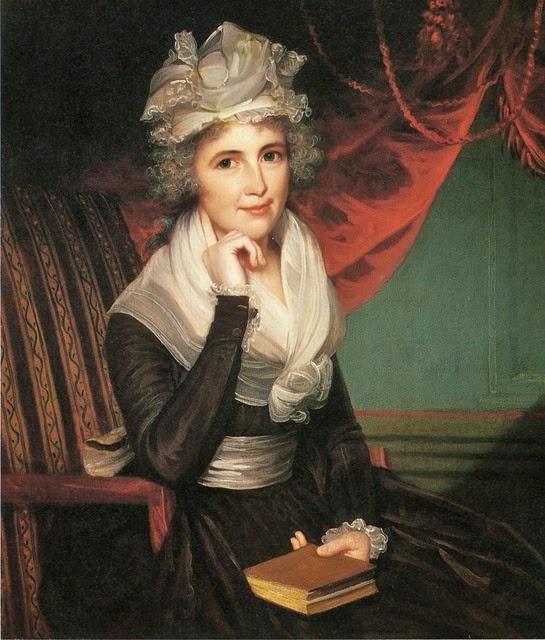
The gown is made of synthetic striped chiffon, and it is lined with black cotton voile.  The fabric was originally crinkle chiffon, and I have spent countless hours trying to iron it flat.  It got pretty close, but you can see that some of the crinkles still remain.  But I had my heart set on having a striped chemise dress like the one seen in this portrait, and this fabric was the only sheer black striped fabric that I could find.

I based much of the construction for my dress on this green silk chemise gown from the 1790's.  I was SO thrilled to finally see a back view of a fitted-back chemise gown, so I tried to make my own gown have a similar back. My pattern mimics the bodice seamlines, waist shape, and skirt pleating, although some changes still had to be made due to my tighter sleeves and the high back of my corset.


Many other elements of my dress were inspired by this chemise gown from the late 1780's, posted by Heileen of the Costume Hysteric blog. Like this example, my dress has tight sleeves with buttons at the cuff, a triple row of drawstrings across the torso, and a ruffle at the hem.

To dress up the ruffle a little, I pinked the edges with some scalloped pinking sheers, and I really like the effect, but I'm not sure how well it would hold up if this dress was going to get a lot of wear and tear.  My chiffon likes to ravel.


I have seen several theories about how these fitted chemise gowns were closed (I wish the museums included this information!), but my personal theory is that most of them have a front slit that is concealed by the gathers in the fabric.  There is a gathered-front jacket on the Abiti Antichi website that shows this type of construction especially well since one side of the gathered front is missing.  My bodice has a fitted under-layer that is pinned closed at the center front, and then the gathered outer layer has a opening that extends a little past the waist.  The drawstrings tie in the center and just get tucked under the gathered outer layer.  There is so much fabric there that you really can't see the opening once it is tied.
DSC00148

I recently had a very interesting discussion with some friends about the difference between dresses made for historical reenactment purposes and "pretty-pretty-princess" dresses.  Although I have tried to base my design on good historical research, the materials and construction of this outfit are 100% precent pretty-pretty-princess... and I'm totally okay with that!  It was a welcome change of pace to make something where I didn't obsess over natural fibers or period construction techniques or try to do tons of hand-sewing.   I think it will be a lot of fun to wear, and sometimes that's all that really matters.

Thursday, July 12, 2012

black chemise gowns


At the DWCG's first overnight event - Costumers' Lost Weekend - we decided to mix things up a bit.   Instead of having a big fancy gala, we're going to have a Mourning Party.  The idea for our mini-con actually grew from a few of us talking about having a "pity party" for the folks who can't make it out to Costume College this year, so we thought it would be cheeky and fun to have a party to mourn the fact that we are stuck here in Texas instead of living it up in LA.

So now I need a black dress that would be appropriate for mourning.  I tossed around a lot of ideas ranging from 1950's to Edwardian to Tudor, but I finally settled into the 18th c. after I stumbled across a few fabulous examples of black chemise dresses.  I had never considered the possibility that chemise dresses could be black, but once I started looking around, I was surprised by how many examples I found of the more somber versions of robes en chemise. It seemed like a really fun choice that is different from the foofy white dresses that you see more often.

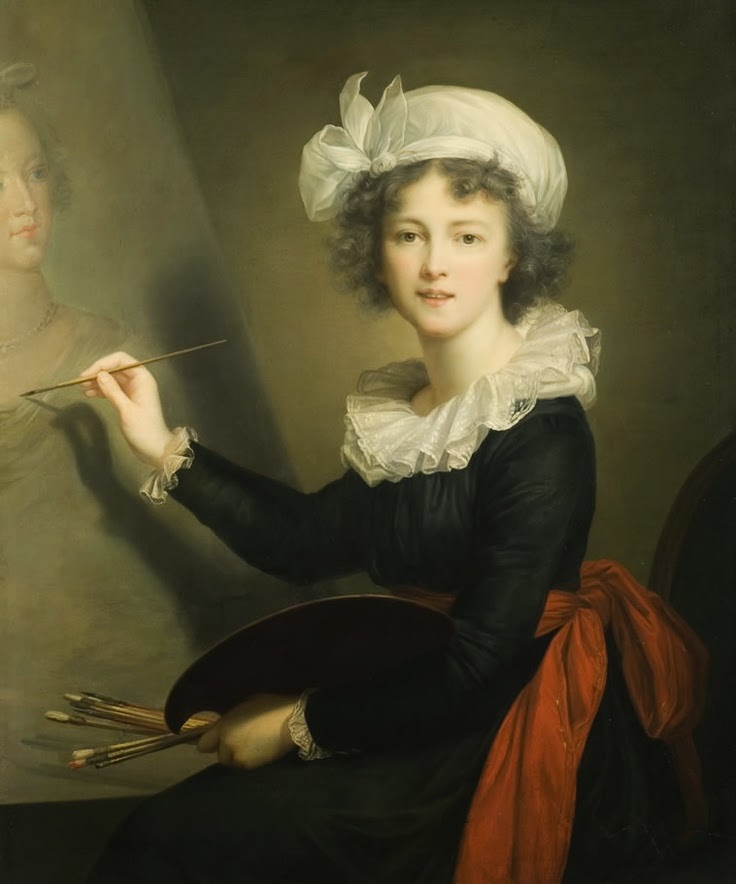
My dress is currently taking shape, and I hope to have some progress pictures that I can share in the next few days.  In the meantime, I thought I would show you all some of my favorite black chemise dresses from 18th c. art.  All of these along with links to the original sources can be found on my chemise gown and late 18th c. luv Pinterest boards.  My dress isn't a direct copy of any one style, but I have combined elements from several of these paintings and illustrations to create my own version of a black chemise.


Sunday, July 8, 2012

site migration progress report

Well, as many of you have already discovered, my old festiveattyre.com website is down now.  I am in the process of transferring my domain name so it will redirect to my new home here on Blogger, but that might take another day or two to start working.  I have made a little process moving the old articles and galleries over to their new homes - you will find them under the "research" tab at the top of the page, just like at my old site.  But I still have a lot left to do, so please be patient with me.  I promise I will try to get it all over here eventually, but I'm in the middle of lots of sewing and planning work for the DFWCG's first ever costume retreat later this month (woohoo!), so I haven't had much spare time to work on it.  But my goal is to have it all back up and running smoothly again by mid-August.

I am SO sorry this is screwing with all of your bookmarks and links, but thank-you for your understanding and for all nice messages that I have gotten from the people who are missing the old website already.  I'm hoping that once everything is moved, I can settle in here on Blogger and not have to move again... at least for another decade.  :)


Wednesday, June 27, 2012

1790 stays

DSC09932

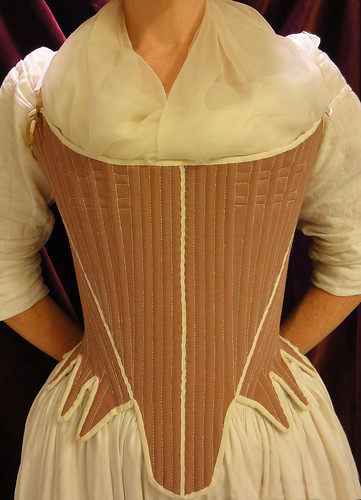
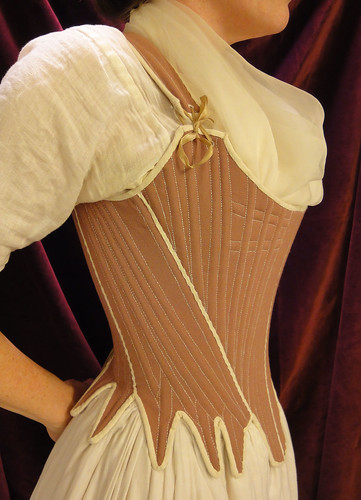
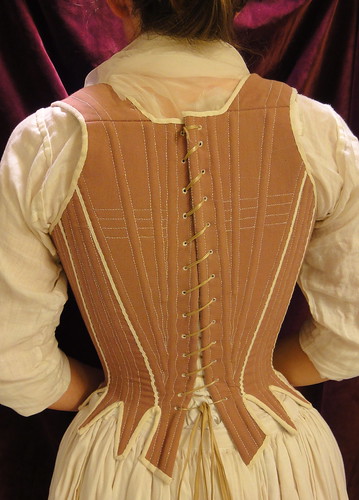
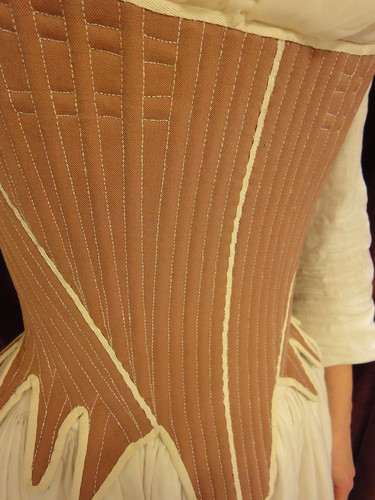
I am finally finished with my new 18th c. stays, so I thought I would share some pics of the finished product along with a few notes about the construction.

DSC09925

DSC09935


I used the 1790 brown jean stays pattern in Jill Salen's Corsets.  The original stays were quite tiny, but they had great proportions to them.  I enlarged the pattern by 118% on my copier, added an inch to the length, and that's pretty much it.  The original owner was obviously bustier than I am, so I probably could have taken some room out of the top, but it still works fine as it is.  I also changed it from front opening to back opening so I wouldn't have to be quite as precise with the fitting.  

My stays are made with a double layer of linen canvas with a layer of pink wool twill on the outside.  They have a lightweight linen lining that I stitched into place once everything else was finished.  The boning channels are hand sewn with 60/2 linen thread, and the different sections of the corset are whip-stitched together with 16/2 linen thread, which BTW was probably overkill because it was very thick and heavy.  The joins are covered with 1/8" cotton tape, and the edges of the corset are bound with 1/2" cotton tape.   It is boned with 5/8" half-round cane.

I made a few rookie mistakes with this project since it was my first time making anything as complicated as a pair of hand-sewn stays, but I learned a ton and I'm sure I'll do much better next time.  I also want to give special thanks to the blog Before the Automobile.  Her most recent stays are a TRUE masterpiece, and her amazing work and incredibly helpful photos and notes are what inspired me to finally be brave enough to make some hand-sewn stays of my own.  

DSC09919

Costume Mythbusters: the case of the gaulle

True of False: A gathered-front 18th c. gown with tight sleeves and a fitted back is known as a "gaulle", vs. a gown that is gathered all the way around and has puffy sleeves, which would be known as a "chemise a la reine".

How would you answer?

If you had asked me this question 2 days ago, I would have answered True without hesitation.  I have read this over and over again online from people who know WAY more about 18th c. clothing than I do, so I believed it as fact.  For the past few years, I have been using this distinction myself and teaching other people to do the same thing.

But earlier this week I started wondering how the term gaulle was actually used in the 18th c., and I fell down a rabbit hole of research and historical fashion nerddom.  The specific way that we have been using the word "gualle" - i.e. as a distinct sub-category of the chemise dress with tight sleeves and a fitted back - is without a doubt FALSE.


To unravel this myth, I decided to look though as many different 18th c. fashion journals as I could find to see what people were calling these gowns at the time that they were made.  I found over 40 examples of gathered dresses in 6 different French and German fashion publications from the 1780's and 90's.*  I have posted  most of these fashion plates along with the period words used to describe them on a Pinterest board for easy reference.  These dresses were called a lot of things, but I did not find one single reference to the word gaulle.  I was amazed!

There are other costume historians who are studying the topic of chemise gowns much more thoroughly, and I am sure there is additional information out there that I have missed.  But from my quick survey of online period fashion magazines, here are some of the things that I discovered:

  • The most common name for these type of dresses was "robe en chemise", which would translate simply to "chemise gown" in English.  Other plates were described by more exotic versions of the chemise title, such as "chemise a la Floricourt", "chemise a l'Anglaise", "chemise Grecque", "chemise a la Jesus", or "chemise a la Reine".  Other texts used the word "chemise" alone and simply added a descriptor for the type of fabric or color, like "ein Chemise von weißem Linon" (chemise of white lawn).  
  • Speaking of "chemise a la Reine", I only found this term used three times and in only one publication, and it was used for the earliest incarnations of this type of gown.  These illustrations were published just a few years after Marie Antoinette started wearing chemise dresses in the early 1780's.  At that point, they were still new and trendy garments specifically associated with the queen.  After chemise-style dresses became more common, the "a la Reine" appears to have been dropped.
  • In the very few instances when the word "chemise" was not used for gathered dresses, they usually were described as morning gowns (du matin) or with the term "neglige", which denotes a dress worn in informal situations.  A few others use the word "fourreau", which seems to mean something along the lines of a shift or a sheath dress.  Two plates were listed as "Creole" gowns, and one of those goes on to describe this as a gown worn by Frenchwomen in America, so maybe this type of garment was a popular choice for the heat of New Orleans.  Finally, one example described the gathered bodice as "en rideau", which means it is like a curtain.  But once again, no references to a "gaulle" anywhere.  
  • I found no distinguishing titles to separate gowns with puffy or tight sleeves, fitted or loose backs, or high or low necklines.  They were all called chemise gowns.  Even in the mid 1790's when the gowns began to morph into new forms with standing collars, deep V-necklines, and were combined with vests or various over-garments, they were still called chemises. 
  • Colored chemise gowns were quite common in fashion plates.  I found examples that were red, pink, peach, yellow, green, blue, purple, grey, and black.  The colors could be muted or very deep.  Colored gowns were listed as being made of muslin, linen, taffeta, and satin, and yet again, they were all referred to as chemise gowns.   
  • Patterned chemise gowns in muslin or silk also existed.  Small dots and stripes were the most common, but I found one example of a chemise gown decorated with stars.   
I have no doubt that the word "gaulle" was used somewhere in 18th c. texts as a creative or exotic title for a chemise dress, but it definitely was not the norm, and it definitely had nothing to do with how fitted the dress was.  And BTW, if anybody knows of an example of the word gaulle used in period literature or fashion plates, I would LOVE to hear from you!  The only example of this word that I could track down was from the painting, Marie Antoinette en Gaulle, which my fabulous art historican friend Sarah from Mode Historique tells me was actually called "la Reine avec chapeau" inVegee-Lebrun's own painting inventories.  It seems that later art historians are the ones who added the term "gaulle" to the title.

But does all of this mean that you shouldn't use the word gaulle anymore?  Well... not necessarily.  You could think of the word "gaulle" like the term "zone gown", which is another modern costume term that was not used in the 18th c.  Neither of these might be historically accurate words, but if historians and costume enthusiasts have agreed to use these words for particular styles of dress, then what's the harm in it?  I just want people to be informed about the historical facts as well, and then you can make an educated choice about whether you prefer to use the modern dress term or the period one.

So now that this myth has been busted, stay tuned to read more about my newest project - a black striped gaulle robe en chemise.


*All of the fashion plates that I used for this survey are found online at these three sources.  If you know of other webbed 18th c. fashion journals that include the original text, please let me know!
Journal des Luxus und der Moden
Bunka Gakuen Library (browse by "History/Age" - there are a number of journals in the 18th c. section)
Gallica copy of Journal de la mode et du goût


Thursday, June 21, 2012

Site migration info

I've been poking around and figuring out some of the more advanced features on Blogger, and the good news is that most of my old site will be able to transfer over here pretty painlessly.  When my old hosting service expires, the festiveattyre.com address will bring you directly here to my blog.  I also figured out how to set up static pages on Blogger, so when you click on the "Research" tab at the top of this page, it will take you to an index of all of my old articles and images galleries.  I have already started moving them, and it is going faster that I had hoped, so I'm hoping most of the research page content will be transferred before the old site goes away.   I have also added all of the new tutorials that I have written here on my blog to the research page to make them easier to find as well.

After the articles and image galleries are moved, I will move the photos of my own costumes, and then if I have any energy left over after that, I might move some of my old dress diaries over here... but I'm not making any promises about those.  The Featured Attyre is the only section that I am not going to move at all.

I'm really excited to see that the best parts of my old site will continue on without too much disruption, and I even more excited to see how easy it will be to add new content in the future.

Wednesday, June 20, 2012

old site, new site


So back in the dark ages of the internet, I had a website that I updated constantly and poured lots of love into: festiveattyre.com.  It was a wonderful outlet that helped me connect with other costumers and chronicle my sewing adventures long before the word "blog" even existed.  But then my son came along and I took a 2 year hiatus from my site to focus on family, work, and the DFW Costumers' Guild.  Then the true death knell came when I discovered the joys of Blogger, and I grew to hate messing with HTML and anything related to my old site.  It is just SO much easier here, and I'm all about easy these days.

Now that my web host is raising their rates to a ridiculous amount, I think it is finally time to let my old site retire.  I plan on continuing my Festive Attyre site here as a pure blog in the future.  I will be re-posting some of the most popular content from my old website here or to flickr over the next few months so it doesn't go away completely.   It won't be exactly the same, and some things will be left to fade away into internet archives, but hopefully the most useful stuff will carry on.  

My old site is scheduled to expire on July 4th, so if there is any old content that you want to save, you might want to save it or print it to make sure you have it.  I plan on moving most of my articles, the Petersons's fashion magazines, and my own costume photos, but it might take me awhile to do all of that.  If you have any requests for things you would like for me to repost here ASAP, let me know and I will see what I can do. 

Thank-you for your support and understanding.  I know this will mess up a lot of bookmarks, but I hope you will forgive me for that.  After 12 years of having a "old fashioned" website, it actually feels really nice to start fresh and move on from the past.  I hope this change will inspire me to work even harder to make this blog my new home.