

It all started when I was flipping though the book Everyday Fashions of the Thirties as Pictured in the Sears Catalogue a few weeks ago, and I was looking for traditional house robes as a possibility for this project. In one 1935 listing, I saw something that looked very much like my idea of a robe, but it was being sold as a dress, and the ad called it a "Hooverette". So what the heck is a Hooverette? Well, I discovered that it was a simple housedress with a robe-like sash and wrap front, and the wrap could tie on either side. That way, if you got your dress dirty while working around the house, you could just switch the overlap and quick as a flash, your dress was presentable again. Considering how often I get stains on my clothes, I thought that was pretty darn brilliant!
I poked around a little online, and found tons of examples of these dresses under a wide variety of names. The term Hooverette or Hoover apron seems to have been a trendy name in the mid-30's (BTW, the book Making History - Quilts & Fabric From 1890-1970 by Barbara Brackman offers some fun theories on how the garment got its name), but they were more often called more simple names in ads from the 1920's through the 1940's such as apron frocks (or dresses), wrap frocks, coat frocks, or house frocks. Amusingly enough, I never found the word "robe" being used to describe them, even though they totally look like robes to me. But after reading lots of ads for these dresses in period newspapers and catalogues, it seems like GREAT importance was placed on women looking nice and completely pulled together from the moment they rolled out of bed every morning, so what could be better than wearing a glorified robe that everybody had agreed to classify as a dress? Here are a few of my favorite ads. Can you imagine having this much pressure on you to look chic while scrubbing the floors and cooking breakfast?
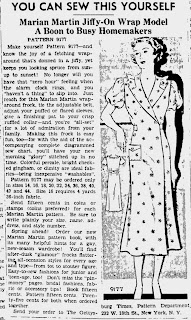 No longer will you have that "zero hour" feeling when the alarm clock rings, and you "haven't a thing" to slip into. Just reach for this Marian Martin wrap-around fock, tie the adjustable belt, adjust your puffed sleeves, give a finishing pat to your crisp ruffled collar - and you are "all-set" for a lot of admiration from your family.
Gettysburg Times - Feb 9, 1937
Open it out flat for ironing and keep it fresh and clean, ready to slip into at any time.... Frame your face with a snowy white collar edges with a dainty, feminine frill. You will be the picture of efficiency and charm all the time you are working.
The Telegraph - Jul 3, 1939
Every woman who loves her home and wants to look pretty in it at all times will love the flattery of the dainty frill that outlines the armholes and yoke-effect... Your family will admire your smart appearance if you choose a fabric of cheery and becoming colors.
The News and Courier - Mar 16, 1937
Several ads mention that these dresses were nice enough to wear to the market or when visitors come over the to house, so to me, these dresses are sort of like when modern women wear their baggy sweats or yoga pants to run errands (but so much more stylish!) Various patterns and ads also mention that they could be worn by professional women such as nurses or beauticians, and one listing mentioned that this type of dress is great for maternity-wear. Others point out that they are a smart style for plus-sized women, with one pattern offering sizes up to a 52" bust.

So after learning about these amazing all-purpose garments, I was excited to try making one of my own. There are several pattern diagrams online that show the shape of wrap-dress pattern pieces (here's a very simple one from the 20's), and for most dresses, it appears that there is just a front, a back, a sleeve, and sometimes a collar and/or a pocket. Easy peasy. I took bits and pieces from 4 different 30's dress patterns in my collection and cobbled together a single dress that looked similar to the examples that I had found online.
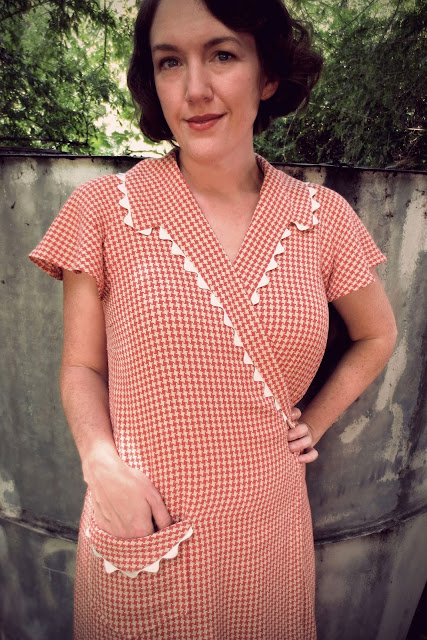
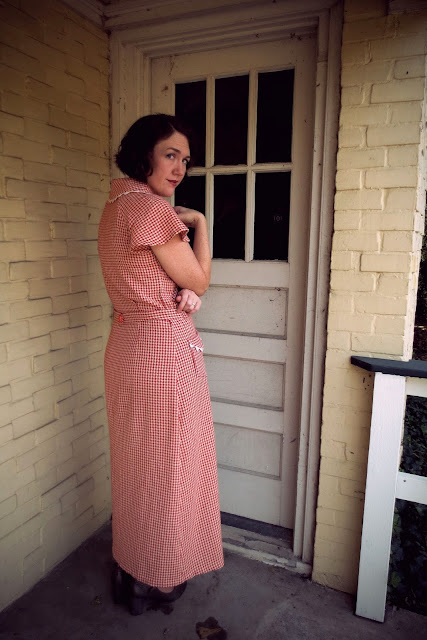
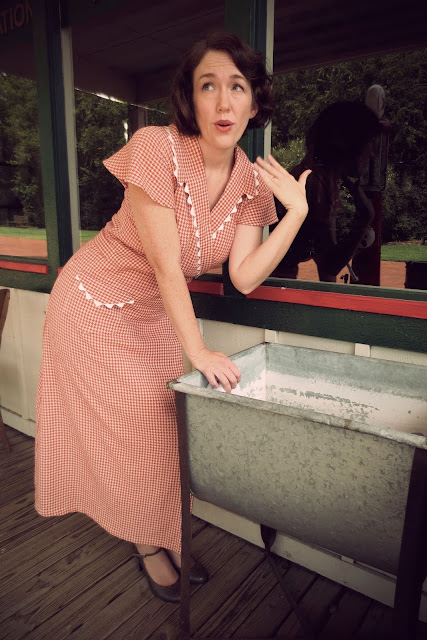
My dress is made out of orange and cream cotton houndstooth fabric that I've had in my stash for years. I had a very small amount of fabric, so every part of my dress has piecing in it somewhere, which I love because I think it feels even more authentic for a depression-era garment. I added some large vintage rick-rack for embellishment around the collar and pocket, and the only closure on the garment is a single vintage button on the back of the belt.
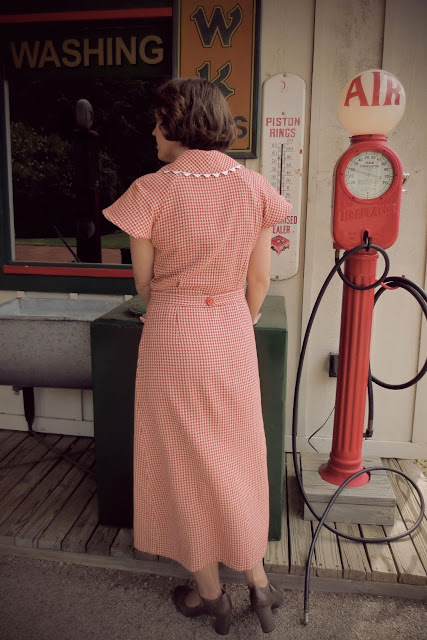
I'm really thrilled by how my dress turned out, and it is so comfy and easy to wear. I can definitely see myself throwing this on the next time I need to make a quick run to Walmart! :)


You can find many more historical examples of these wrap-style frocks on my Hooverettes and Housedresses Pinterest board, and I have a few more pictures of my dress on Flickr.
 No longer will you have that "zero hour" feeling when the alarm clock rings, and you "haven't a thing" to slip into. Just reach for this Marian Martin wrap-around fock, tie the adjustable belt, adjust your puffed sleeves, give a finishing pat to your crisp ruffled collar - and you are "all-set" for a lot of admiration from your family.
Gettysburg Times - Feb 9, 1937
Open it out flat for ironing and keep it fresh and clean, ready to slip into at any time.... Frame your face with a snowy white collar edges with a dainty, feminine frill. You will be the picture of efficiency and charm all the time you are working.
The Telegraph - Jul 3, 1939
Every woman who loves her home and wants to look pretty in it at all times will love the flattery of the dainty frill that outlines the armholes and yoke-effect... Your family will admire your smart appearance if you choose a fabric of cheery and becoming colors.
The News and Courier - Mar 16, 1937
Several ads mention that these dresses were nice enough to wear to the market or when visitors come over the to house, so to me, these dresses are sort of like when modern women wear their baggy sweats or yoga pants to run errands (but so much more stylish!) Various patterns and ads also mention that they could be worn by professional women such as nurses or beauticians, and one listing mentioned that this type of dress is great for maternity-wear. Others point out that they are a smart style for plus-sized women, with one pattern offering sizes up to a 52" bust.

So after learning about these amazing all-purpose garments, I was excited to try making one of my own. There are several pattern diagrams online that show the shape of wrap-dress pattern pieces (here's a very simple one from the 20's), and for most dresses, it appears that there is just a front, a back, a sleeve, and sometimes a collar and/or a pocket. Easy peasy. I took bits and pieces from 4 different 30's dress patterns in my collection and cobbled together a single dress that looked similar to the examples that I had found online.

My dress is made out of orange and cream cotton houndstooth fabric that I've had in my stash for years. I had a very small amount of fabric, so every part of my dress has piecing in it somewhere, which I love because I think it feels even more authentic for a depression-era garment. I added some large vintage rick-rack for embellishment around the collar and pocket, and the only closure on the garment is a single vintage button on the back of the belt.

I'm really thrilled by how my dress turned out, and it is so comfy and easy to wear. I can definitely see myself throwing this on the next time I need to make a quick run to Walmart! :)


Whew! Pretending to be a good 30's housewife is hard work!
You can find many more historical examples of these wrap-style frocks on my Hooverettes and Housedresses Pinterest board, and I have a few more pictures of my dress on Flickr.