I made this dress for a
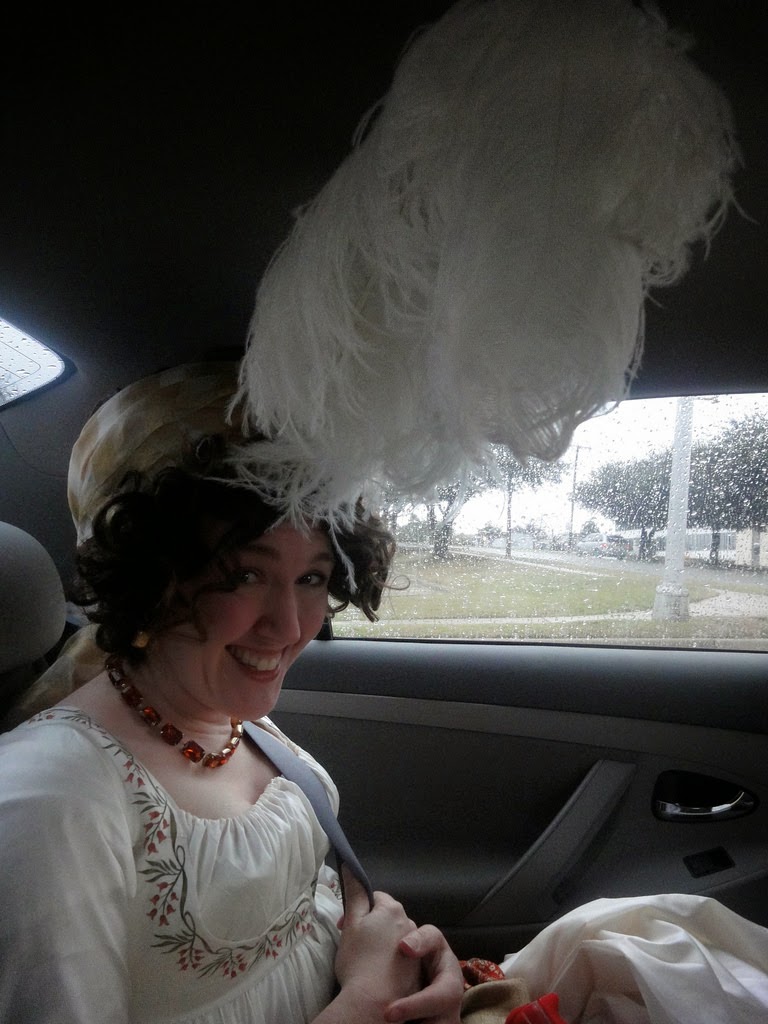
Regency dinner party with a few of my dearest friends way back in March, but it was dark and rainy and my hair didn't want to cooperate that night, so I didn't get very many blog-worthy pictures of the dress at that time. I kept thinking that I would get dressed up again and do a photoshoot during the spring, but then life happened and time just slipped away. Part of the problem is that this outfit seems too fancy for most of my usual photoshoot settings. Plus, once I add 24 inches of ridiculous feathers sticking straight off the top of my head, I'm well over 7 ft. tall, and that's no fun in a car, as you can see from one of the photos from March! So I made myself a little backdrop in my sewing room last weekend and took some pics that I am finally happy to share.
The inspiration for this dress came from two major sources. First, I fell in love with the shape of this 1797 printed gown from the
Musée de la Toile de Jouy. It is almost like an open robe with those flaps under the bust, but it appears to be all one piece like a round gown. I don't think I ever found another example quite like that, but I love it like crazy so I decided to do something similar with my own dress.
But I also fell in love with the idea of painting a design on my dress. There are loads of examples of painted dresses from the 18th century, but it seemed to be less popular during the Empire period. But I did find a several examples of Empire dresses with painted borders in
Gallery of Fashion, webbed by the
Bunka Gakeun library. One of my favorites was this dress that is described as a "robe of white tiffany, with a painted border of vines".
Painted textiles during this period were typically made with tempera paints, but I couldn't imagine doing work like this with a paint that is water soluble, so I cheated and used satin finish acrylics instead. It took quite a bit of trial and error before I came up with a design that I liked, but my final pattern was inspired by the top design this 1815 embroidery pattern sheet from
Ackermann's Repository. EK Duncan has webbed a large number of these embroidery patterns on her website,
My Fanciful Muse, and they were an enormous help when I was creating my design.
The painting was a bit long and tedious, but not particularly difficult. My research found that the fabric "tiffany", which was mentioned in the painted border fashion plate, could be a thin silk similar to taffeta. I was thrilled to find some semi-sheer silk taffeta at my favorite local fabric store,
Fabrique, that seemed like it would be a good modern substitute for tiffany. It made painting a million times easier because I was able to draw off a few repeats of the design, then create large stretches by splicing copies of that drawing together. I was able to place this pattern under my fabric while painting so I didn't have to transfer the design to my fabric at all. I painted each section in stages (leaves, then flowers, then final shading) to streamline the process. I painted the bodice and sleeves before assembly because I wanted to line those areas and I wouldn't be able to see my pattern once it was assembled, but I painted the skirt after hemming since it was unlined. My original design idea used a very wide border with lots of different colors, but even though I'm a fast painter, I had to scale it back by a LOT because it took so much longer than I expected.
I drafted my own pattern for this dress by altering the pattern from my
1790s round gown. The silk on the bodice is flatlined with white cotton so that the color would be consistent compared to the fabric over my chemise sleeves and petticoat, and then the bodice is lined with linen. The gathered front section and sleeves are lined with white voile since they are so sheer and I don't like seeing too much of my undergarments through the dress. The bodice closes with lacing on the foundation layer, then the front is gathered down on two ties at the neckline and waist, then the outer bodice flaps hook in the center front. To conserve fabric the gown is pieced in several places, which you can see here under the arms. The entire dress is hand-sewn using 18th c. sewing techniques with linen and silk thread.
To finish off the outfit, I am wearing my collet necklace and earrings from
Dames a la Mode and a super long
paisley shawl. My turban and feathers are huge and crazy and fun, but I think I liked the simple look even better when I switched out the turban for a brass headband, which is actually a repurposed Victorian papier mache bowl handle.
I realize that this style of dress is a bit of an acquired taste. The crazy high backs and kooky headwear are pretty odd looking, and the heavily gathered skirts are not the most slimming fashions ever created. But for some reason, I just can't get enough of these late 1790s dresses! There is just something about these fashions that feel so elegant and exotic when you wear them. Here are some of my favorite pics, and there are a few more on
flickr.