Wednesday, March 13, 2013

30s Beach Pajamas


For this week's Sew Historical Fortnightly challenge, we were supposed to make something that fit the theme "peasants and pioneers".  I decided to take a slightly less literal approach with this one and use it for a project that I've been dying to make for a few years now - a set of 1930's beach pajamas.

The "peasant" part of this challenge comes from the blouse, which I made out of a printed feedsack that I picked up in an antiques shop years ago.  The feedsack was only 46" long, so it took some very careful planning and piecing to make it work from just one bag.  Printed feedsacks like this one were a popular money-saving choice for home seamstresses during the Great Depression and WWII, so it seemed like a great choice for this challenge.  I'm no expert on dating feedsacks, but I'm guessing that this print with its happy little cherries is actually from the 40's instead of the 30's, but shhhh... let's keep that secret between ourselves!  ;)

I used a New York pattern with the blue eagle NRA stamp on it, which means that it was sold between 1933 and 1935 under the umbrella of Roosevelt's New Deal recovery programs.  I love finding little clues like this to help date patterns, and I thought that using an authentic depression-era pattern would also fit the peasant challenge perfectly.  The only change that I made to the pattern was to make the collar open instead of closed with a bow, which seemed a little prissy for beach-wear.


For the "pioneer" part of this project, I decided to honor the fashion pioneers of the 30's who finally began breaking the gender barriers that had always been associated with women's pants.  A few brave women had been experimenting with various forms of trousers since the bloomer era, but it was really the 1930's that marked a turning point for this article of clothing.  Although I like playing dress-up in pretty frocks for my costuming work, my real-life wardrobe is made up of slacks, capris, and jeans about 99.9% of the time, so this is my little tribute to those amazing fashion-forward women of the 30s who paved the way for a trouser-loving girl like me.

I have always adored the super-wide legged look of the 30's.  I think they are so glamorous and fun, and I've been dying to make a pair for myself.  I used an Anne Adams pajamas pattern from the mid-1930s for my pants, and luckily, they fit me perfectly with no alterations needed except for the length.  Some modern costumers seem to be a bit freaked out by the fit of 30's pants, but I really love the way these look on me.  I admit that the crotch is crazy low and the waist is crazy high, but somehow it all works.  I made these out of linen canvas from my stash, and I used vintage mother-of-peal buttons for the sides.

The only problem is that it is hard for me to decide whether to wear the blouse tucked in or out.  I think it looks a little more leisure pajama-ish with the shirt out, and more beach pajama-ish with it tucked in.   I have to admit that I'm more comfortable and less self-conscious with the shirt out (did I mention how crazy high those pants are?), but I miss seeing the buttons on the pants when I wear it that way.  But I'm sure I'll wear it both ways from time to time just depending on my mood.  It's good to have variety.

For more beach pajama inspiration, check out two of my favorite photo blogs - Giant Pants of the 30s and La Mode Pyjama.  I also have a few additional photos of this outfit on my flickr.


Tuesday, February 26, 2013

a pirate bicorn


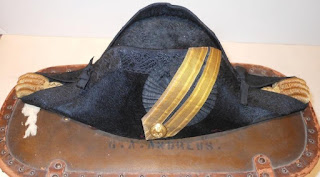
The latest Historical sew fortnightly challenge was "embellish".  Since this is a busy time of year for me, I decided to keep things simple and just decorate a hat.  I bought a bunch of wide-brimmed wool hats from Target last year, and I thought these would make a wonderful pirate hats.  All they need is some wire around the edge and a bit of trimming.

Before: floppy and boring...

After: piratey and AWESOME!

I bought the vintage trim that I used around the edges at the Antique Elegance show two weekends ago, but everything else came from my stash.  After I wired and bound the edges, I folded the brim up and stitched the edges together at the sides to keep it in place.  I also added tassels to the ends like you see in some period bicorns, but I chose tassels that were raggedy and worn to make it look more pirate-ish.  I decorated the front with a ribbon cockade made with the wonderful instructions on the blog Idle Hands (part 1 and part 2).  I also added a bunch of feathers to the top based on two 1780's fashion plates from Galerie des modes et costumes français showing women wearing heavily embellished bicorns.


And that's pretty much it!  All of the embellishment was hand-sewn, and it probably only took me 3 hours from start to finish.  Here are a few more pics to show how it looks for other sides.


Sunday, February 10, 2013

Curtain-Along Pocket, Meetup, and Give-away


It's been a while since I've posted anything about the Curtain-Along, but I definitely haven't forgotten about it.  In fact, I've just been waiting to make sure of a few things before making this announcement:

We are going to have a Curtain-Along meetup at Costume College this summer!  


I am SO excited to be able to attend Costume College again this year, and I've been consulting with some of my friends about a good day to do a meetup for this project.  Most of the people that I've talked to have voted for Friday or Saturday during the day, and personally, I'm learning toward Friday so we can meet everybody and make some new friends early in the conference.   But I'm still open to changing that to Saturday if you all know of any big conflicts that I'm not aware of.  We still have until August to nail down an actual time and location for our gathering, and I'll keep you updated with more info later in the spring.  :)

And while I still haven't found the time to make my Curtain-Along jacket, I was able to sneak in a smaller curtain project for the Historical Sew Fortnightly undies challenge this week.  I made a patchwork pocket inspired by this one from the Winterthur Museum.

I used one of the curtain tie-backs to cut blocks of the printed fabric, and then I dug out some scraps from my ikat open robe for the blue pieces.  The striped binding and backing fabrics are also from my scrap bin.   I cheated a little and machine-sewed the piecework, but the binding is sewn by hand.

The most noteworthy thing about this project was discovering how HUGE 18th c. pockets were!  The original pocket that I based mine on is 16" long.  When I blew it up to full size to make a pattern, I thought it must be a mistake because it looked so crazy big.  I even made one of my students model it so you can see the scale.   But it is definitely not a mistake.  When I looked at other examples I discovered that this size is actually quite average.  I had no idea!   We decided that 18th c. women must have been carrying whole chickens around in these things.  For my own version of this pocket, I reduced the length to 14", which is still quite large, but at least my hands can reach the bottom of it now.


Just for a bit of fun when I wrap up the Curtain-Along in September, I thought I would do a giveaway with this pocket as the prize. We can make a final list of all the Curtain-Along projects that people have made this past year, and then I'll hold a random drawing and send this pocket to one lucky person as a little thank-you for participating.

And just as a reminder, check out my Pinterest board for all of the pin-able Curtain-Along projects that I know of so far.  If you have seen others or have made something yourself, please let me know so we can all check them out.  And remember, if you don't have a blog, I am happy to feature your work or let you do a guest post here too.  If you are new to this project or just looking for inspiration, I also have a board of Georgian Indienne print inspiration pics to get you started.

Happy curtaining!


Sunday, January 27, 2013

Pirate UFO


For this week's Historical Sew Fortnightly challenge, we were supposed to complete a "unfinished object".  I have a number of UFO's in my sewing bin, but the project that I most wanted to finish was a pirate costume that I started six years ago.  I was originally making this to wear to the a Pirates of the Caribbean premiere, and I was SO in love with my design concept, but then I got pregnant and this project was placed on hold due to my growing belly.  But every year or two, I start thinking about how much fun it would be to wear a pirate costume to faire.  I've dragged it out several times over the years and made attempts to work on it some more, but unfortunately, I never can seem to make much headway.

And once again, life has thrown up roadblocks on this project, and I didn't get as far as I had hoped.  But I did finish the petticoat, so that's better than nothing.  I keep reminding myself that this is an unfinished OBJECT challenge, not an unfinished OUTFIT challenge, so I'm counting this as a minor victory anyway.


The petticoat is made out of some machine embroidered voile that I bought on clearance for next to nothing.  It's not authentic, but I thought it was reminiscent of the beautiful embroidered petticoats from the 18th c.  The construction is based on petticoats like the ones covered in this tutorial.  The only thing creative about this whole project is that I spent a lot of time distressing it so that it looks worn and old.  I dyed and splattered the hem with a mixture of brown and dark green dye.  Then I ripped holes all along the bottom and tried to fray the bottom edge.  I also stitched up some of the rips with some hand-spun yarn, and I added a few patches here and there with scraps of striped fabric.


I'm going to continue working on the jacket over the next few weeks, and I hope to have the whole outfit done in time  for the embellish challenge.  I've changed up the jacket design quite a bit from my original sketch - the big frockcoat looked great in the drawing, but when it started coming together, I discovered it was much less flattering in real life.  I'm still not 100% sure what the jacket will look like when I'm done, but hopefully I'll figure something out this month.


Sunday, January 13, 2013

a dress for the Titanic


I was so thrilled to discover that he next challenge for the Historical Sew Fortnightly corresponded perfectly with the DFWCG trip to the Titanic Artifacts exhibit at the Ft. Worth Museum of Science and History.  So my entry to the centennial challenge is a complete 1913 outfit based on this reproduction dress pattern from Past Patterns, which is listed for the years 1911-1914.

I enjoyed working with this pattern, and I am very pleased with the way the dress turned out.  One of my friends recently asked me if I would recommend this pattern to others, and I would have to answer that with a conditional yes.  If you are comfortable making a dress with no instructions, you are good at resizing, and you just want some basic pattern shapes to get you started, then this is a really nice authentic historical pattern.  I love the shape of the skirts, and there are very few pieces in this dress, so it goes together quite quickly.  There were a few odd areas, like the fact that the bodice is HUGE!  I had to take 4" out of the circumference of the bodice, and took another 3" off the length.  The skirt runs a little short too, so if you are tall, you'll want to add quite a bit to the hem. The only other major change that I made was substituting a shawl collar for the ruffled one just to make it more tailored looking.  But other than those small alterations, I thought the pattern came together very well.

But... and this is a pretty big "but"... there are NO helpful instructions on this thing at all, and you need to be somewhat familiar with 1910's construction methods or you will be completely lost.  It took me 2 days of head-scratching and theorizing to figure out how to close the dress, and I'm still not sure I did it correctly.  I finally went with a center-back closure with snaps that opened from mid-back to the hips, because that is the only way you could have the collar connect across the back (unless there is a split in the collar, which would just be weird).

Also, it helps to know that 1910's dresses often used lapped and top-stitched seams, and the center-front panel of the skirt and the lower sleeves on this dress are both joined this way.  The edge of one piece gets folded under and ironed, then you place it over the next piece and stitch them together from the top, which makes a decorative flap of fabric that looks like a tuck.  It's a fun little detail, but I only knew to do it like this thanks to another antique 1910's pattern that I made up that had much better instructions.   Anyway, if you decide to give this pattern a try, these are the two best tips that I can give you, and hopefully the rest is more straightforward.


My favorite part of this project was making the hat.  I wish I could show or tell you more about how I reshaped it, but I didn't take any in-progress photos because it looked like a such complete hot mess until the very last minute that I was convinced that it was going to be a failure.  But mostly, I just wet the hat and then kept stretching and ironing and re-steaming it over my generic hat block until I eventually bent it to my will.  I was too lazy to go by gelatin to make proper sizing for it, so once it was shaped and dried, I painted a few coats of fabric stiffener on it, and that worked great too.  I love these mid-teens hats that are more vertical vs. the wide-brimmed variety that you more typically see from the early 1910's, so I had a blast making this one. I totally love the weird asymmetry and crazy plumes shooting off in odd directions (here's a great collection of examples). Although the dress could pass for a wide variety of years in the early 'teens, the hat style is very 1913, so I thought it would be a nice finishing touch for the SHF challenge.

This was a 100% stash project, which was fun and very satisfying.  I only spent $1 on a bit of interfacing for the collar, and everything else came from odds and ends that I've had hanging my sewing room for years and years.  My dress fabric came from estate sales - I think it was $5 for a large trash bag completely filled with fabric.  I picked out two shorter lengths of fabric that I couldn't do much with on their own, but when combined together, I had just enough for this dress.  The burgundy velvet came from an old bedskirt, and the tassels were freebies from my husband's work.  I bought the wool hat blank on clearance from Target last year (I still can't figure out how on earth you were supposed to wear a floppy, wide-brimmed blank as a modern hat!), and the feather, shoe buckles, and eyelet dickey were all odds and ends from the Antique Elegance show that I picked up with no specific project in mind, but they were too cheap to pass up.  Lately I've been trying really hard to not buy fabric or other costuming materials unless I have an actual project in mind for it, but this outfit totally justified collecting a bunch of random materials "just in case" from time to time too.  I have decided that 2013 is going to be the "year of the stash" for me, and this was a great project to get the ball rolling.

So that's about it.  You can see more photos of all of the fabulous 1910's ladies and gents from the DFWCG on flickr, and here are a few more shots of my dress for good measure.


Wednesday, January 2, 2013

a natural form corset

So I'm sure most of you know about the very cool Historical Sew Fortnightly project that is going on in 2013.   I wasn't sure if I should join this one because my project calendar is already packed to the brim, but it just looks like so much fun that I can't resist!  I know I won't be able to do all of them, but if a project that I already have planned happens to correspond with a challenge, then I figured I might as well join the party!

So luckily, the first challenge happened to line up perfectly with a goal that I had already set for myself for the last week of 2012:

 #0 (the bonus challenge): Starting Simple - due 31 December NZT.  Finish a project, make a very simple garment, or something you have made before.  


I'm not sure if a corset counts as "very simple", but it was something that I had made before and I knew I could knock one out before the New Year.  I also have several new Victorian dresses that I am wanting to make in 2013, so it seemed like it would be a good idea to get the corset out of the way early so I could focus on the dresses when I am back at work and have less time on my hands.

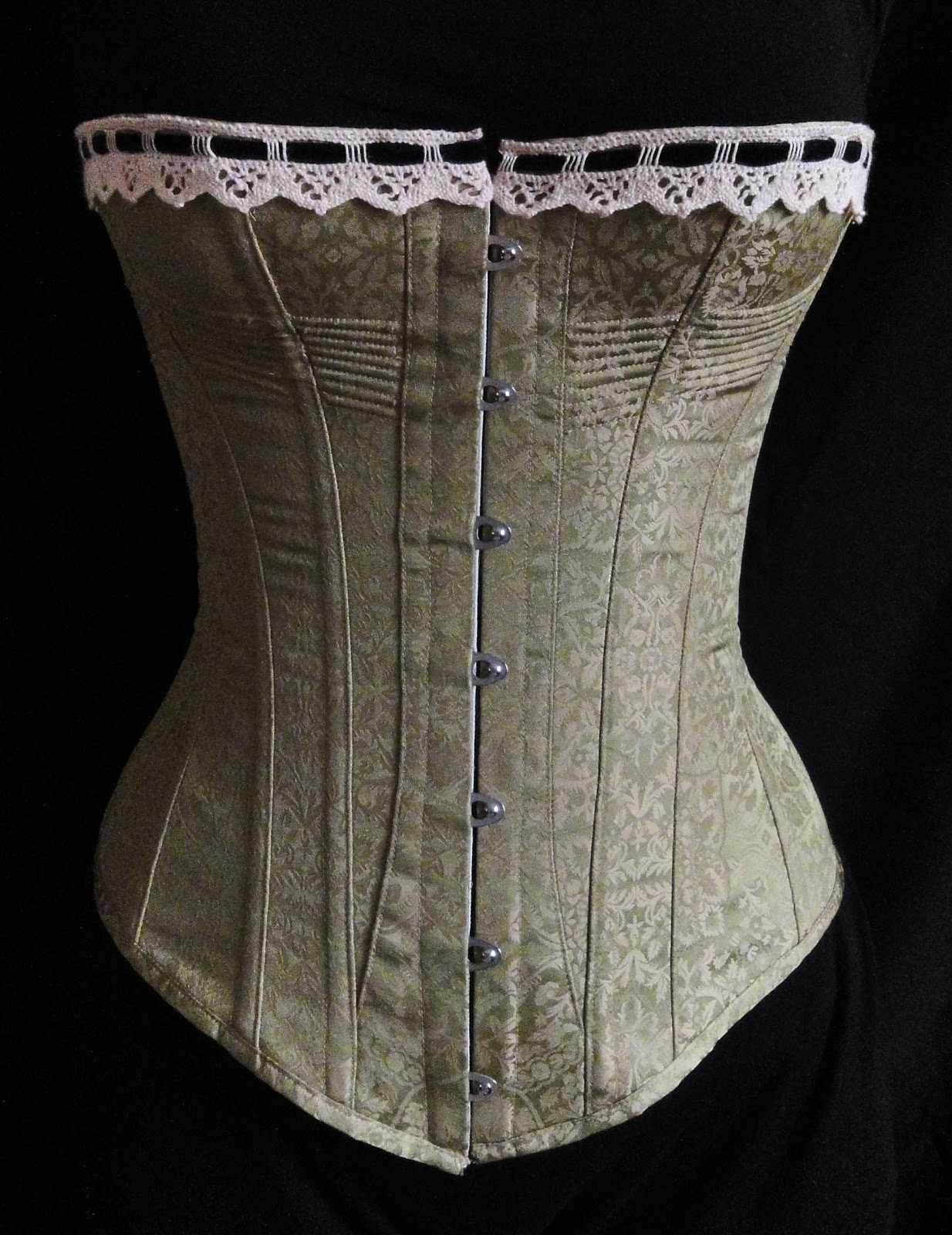
So I looked at a variety of patterns of corsets from the years 1875-1885(ish) and made paper mockups to compare the shapes and see which one I liked the best. The paper mockup on the far left is a 1877 corset from a de Gracieuse pattern diagram. It makes a pretty shape, but it was way too high-waisted to work on my body.  The middle one was the 1880's corset from Corsets and Crinolines, but I decided against this one because it didn't seem very curvy.  The one on the right is the 1880's "exotic" corset from the book Corsets.  I loved how curvy this one was, so I decided to give it a try.

I enlarged the pattern to 113% so it would come closer to fitting my waist measurement, but I didn't make any other changes to the bust/waist/hip proportions, and I followed the pattern as precisely as possible.  However, I am tall and pretty long-waisted, so I had to add 2" onto the torso to make the bust hit me in the right place.  I also had to remove 2" from the bottom edge in front because it was so long over my belly that it buckled when I sat down.  I'm guessing that this corset was meant for a lady with a higher waistline than mine, but I don't like having the tightest part of the waist hit at my ribs, so I deiced it was worth making some adjustments.  

Even though I didn't change any proportions other than the length, I was surprised at how non-curvy my corset turned out when compared to my paper version.  To be honest, I'm a little boggled by it considering how little I changed the pattern. The only thing that I can guess is that the extra length makes the curves less apparent, or maybe I'm just not busty enough to fill out the top as intended.  But even though this corset didn't turn out exactly how I had hoped it would, I still think it'll work fine for my projects this year.  The shape will be nice and smooth for natural form styles, and it also reminds me of the long and lean corsets from the 1890's like the one on the right.  It'll be a good foundation garment to have in my closet.

My corset is made with silk brocade and coutil treated as one layer, and the spiral steel boning is held under tapes on the inside.  The original corset was boned with cane, so I left off some of the boning channels on my version since the steel is so much stronger.  However, the missing boning caused the top to wrinkle under the bust a little, so I added cording in that area like the example from Corsets and Crinolines to add a bit more support.  I still need to add flossing, but I'm going to put that off for sometime further down the road.  Maybe that can even be my entry for challenge #4 - Embellish!  


Wednesday, December 26, 2012

snow-day photoshoot

I hope you all had a wonderful holiday!  This year, we were treated to a very rare white Christmas in Texas, and my whole family had so much fun frolicking in the snow.

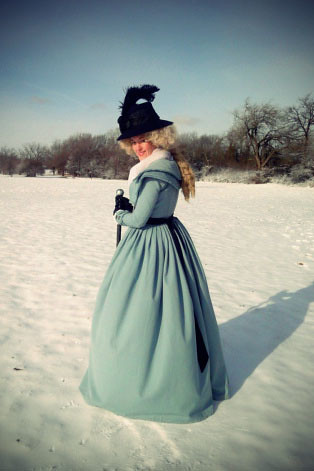
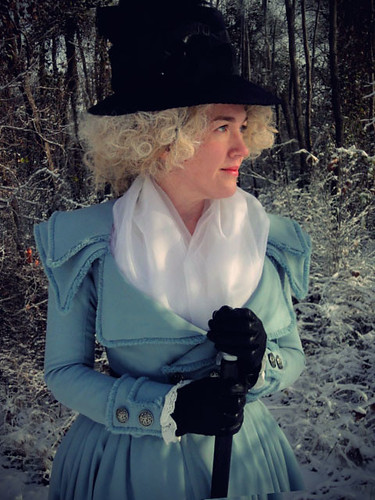
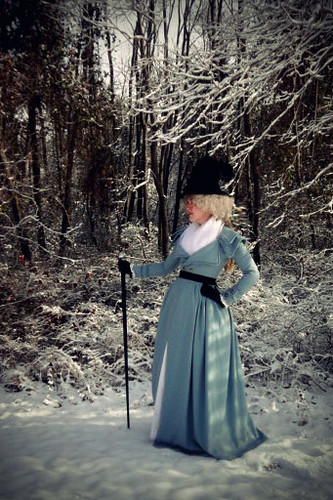
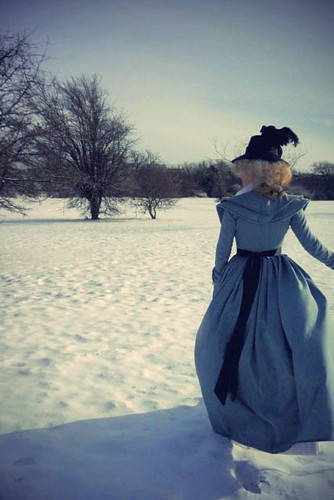
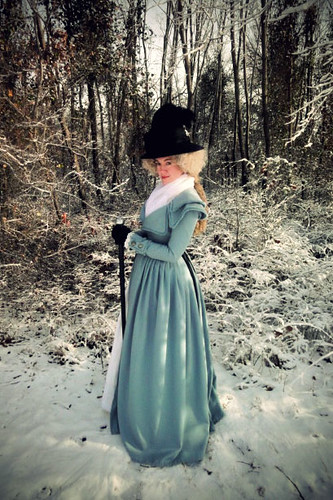
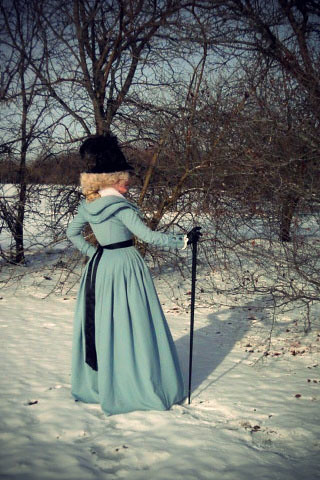
Since I didn't get a lot of good posed pictures of my new redingote last month, I decided to make use of the pretty winter backdrop today and snapped a few more pics at the park.  It was so much fun wearing this outfit in cold weather.  I stayed nice and warm in my gown, and the colors seem to go so perfectly with the snow and bare trees.  I could have kept going for hours, but my son decided that more snowball fights were in order, so I changed back into my street clothes and returned to 21st century mom-mode.  Unfortunately, my camera doesn't like cold weather and all of my pictures are a bit out of focus and hazy, but we're going to call that blurriness "artsy" and go with that.  ;)  But anyway, it was a fun little excursion and a perfect Christmas gift from mother nature for a costume nerd like myself.
DSC06255


DSC06262


DSC06271


DSC06233


DSC06272


DSC06254


DSC06250


DSC06234


Monday, December 3, 2012

A late 20's dress for Lanternlight


This past Saturday, a group from the DFWCG attended Plano Heritage Farmstead's holiday celebration - Lanternlight.  The theme for this event is usually turn-of-the-century Victorian/Edwardian, but this year they switched things up a little and did 1920's, which was SO much fun! 

In the past, I've kind of turned up my nose at 20's fashions because I don't find them to be the most flattering styles, but I've really come around over the past few years and I'm enjoying them more and more.  I've discovered that not all 20's dresses look like shapeless feedsacks, and some of the styles are really chic and fun to wear. 


For my dress, I used an undated Pictorial Review pattern, which I am guessing from the styling is from 1930-32ish.  But you can see from the pattern diagram on the back that there is almost no shaping in the dress, and I discovered that if you wear the belt at the hips and shorten the skirt a little, it passes for a 20's dress with no problem. You could really see the changes going on in the pattern industry with the way this pattern was made.  It has a very brief instruction sheet like older patterns with only the most basic construction steps covered, but then it also has printing on the pattern pieces with cool little illustrations and extra hints and tricks for how to put it all together.  Compared to the other 1910's and 1920's patterns that I own, this wealth of information must have been such a welcome change for home seamstresses!  The only changes that I made to the Pictorial pattern was to leave off the cuffs (no good reason why - I just got lazy), and I also omitted the collar so I could wear a fur collar instead. 


Although you see a ton of fur collars on coats in the 20's, it's much harder to find them on dresses.  I got really excited when I found this 1927-28 dress illustration in the book Montgomery Ward Fashions of the Twenties (there's a link at the bottom of this post), since it appears to have an attached fur collar and it looks so similar to my dress anyway.  But there is nothing noted about it being fur in the text, so I'm guessing it was really some type of velvet or plush.  I have occasionally seen photos of women with fur collars worn with a dress, like this one, but I'm pretty sure most of those are stoles instead of anything that is attached.  Obviously, it doesn't make sense to put fur on a dress that needs to be washed, but I was really determined to have a fur collar on this outfit, so I did it anyway.  Shhh... don't tell the authenticity police!  I found this clip-on fox fur collar on etsy, and since it is not permanently attached, I can still wear the dress and wash the dress without the fur, so I don't feel quite as guilty about it. 
My dress is made from polyester crepe, which is another strike against me on authenticity.  But I had my mind set on making it in deep red, and when I was buying fabric for it last summer, this is the only dark red crepe that I could find.  The buttons and belt buckle are all vintage mother of pearl.

For the hat, I reshaped a modern wool felt hat using my vintage hat block.  I'm kicking myself for not taking pictures of that process now, but I was so tired this past week that it never crossed my mind until I was almost done.  But all I did was wet the hat and stretched it and pinned it over the block so it would sit down much farther on my head.  Once it was dry, I cut the brim to a shape that I liked, then wired and bound the edge of the brim with a strip of silk taffeta.  For the decorations, I had originally planned on making some fancy fabric flowers, but I ran short on time, so I ended up buying a huge velvet poinsettia from Hobby Lobby, and I hot glued the individual petals onto the hat. 

The shoes are from Aerosoles, and they are called Ticker Tape.  I thought they were so perfect for 20's costumes, and they were quite comfortable too.  I just replaced the leather cord with a ribbon since I didn't like the way the cord looked on its own.  Aerosoles has quite a few retro-styles of shoes, and they have good sales too if you are patient and keep checking back. 

So that's about it.  I had a blast wearing this costume, and I was pleasantly surprised at the number of compliments that I received at the event.  I guess 20's dresses might not be so terribly unflattering after all.  ;)  You can see more pictures from the event on my Flickr page.